


A sore backside can make a short ride feel surprisingly long, especially after time away from cycling or a change in bicycle setup. The answer to how long until bike seat stops hurting varies: mild tenderness may ease as your body adapts, but persistent or worsening pain can signal a saddle-fit, position, clothing, or health issue that deserves attention.
There isn’t a reliable countdown that applies to every rider. Saddle width and shape, riding posture, how long you ride, and where pressure occurs all matter, and a softer or wider saddle isn’t automatically a better match. If you’re comparing recreational options, our guide to a Jetson bike seat and overview of compact bike-seat options offer related product context. The products below include different designs, so check their stated features and mounting information rather than assuming one will resolve discomfort.


Pros
- Built-in rear taillight streamlines nighttime warning visibility without cluttering limited seatpost space
- Dual-spring suspension paired with thick memory foam significantly dampens pavement chatter
- Ergonomic center cutout reduces perineal pressure and improves ventilation on warm rides
- Universal mounting bracket enables easy installation across commuter, cruiser, and stationary exercise bikes
Cons
- Operates on replaceable coin-style batteries rather than modern USB rechargeable power
- Manufacturer does not list specific lumen ratings, runtime duration, or selectable flash patterns
- Wide 10.2-inch profile is optimized for upright cruising and may hinder aggressive road cycling positions
The DR BIKE Wide Bicycle Saddle with Built-In Taillight is an oversized comfort replacement seat engineered for commuters, casual road cyclists, and neighborhood riders seeking enhanced rear visibility alongside supportive cushioning. By integrating a warning rear light directly into the back edge of the saddle, this design eliminates the clutter and slippage often associated with separate seatpost-mounted lights. It is well-suited for everyday riders looking to upgrade from firm factory seats while adding an immediate layer of low-light awareness.
Lighting performance centers on a built-in waterproof warning light positioned high beneath the rider to ensure a clear line of sight for trailing motorists. The fixture arrives ready for use with two included batteries, providing simple on-demand rear warning illumination without requiring immediate accessory purchases. While the manufacturer specifies waterproof protection for the lighting casing, specific lumen output, beam throw, and flash modes are not officially stated. Riders should consider this built-in light a practical presence marker that alerts surrounding traffic rather than an ultra-high-output standalone strobe.
Comfort and physical construction are built around an oversized 10.2 by 7.4-inch platform designed to evenly distribute rider weight across sit bones. The core utilizes high-density perforating memory foam supported by dual underside suspension springs, which help dampen potholes, railroad crossings, and rough asphalt. For added peace of mind, DR BIKE encloses the dual steel springs in rubber rings to prevent pinched fingers during installation or bike maneuvering. A hollow central ventilation channel promotes active air circulation, reducing moisture buildup and relieving pressure during warm summer commutes.
Mounting versatility is supported by an included universal mounting clamp compatible with most standard bicycle seatposts, cruiser posts, and stationary exercise equipment. Because the rear light is molded cleanly into the saddle casing, it leaves the entire seatpost open for tool bags, reflectors, or physical height adjustments. Daily handling is simple, requiring only an occasional wipe-down with a damp cloth and periodic checks to confirm that the rear light lens remains clean and tightly seated.
There are several practical ownership trade-offs to keep in mind before purchasing. The integrated taillight utilizes replaceable batteries instead of a USB-C rechargeable internal cell, requiring riders to carry spares or replace coin cells over time. Furthermore, without published runtime metrics, riders must visually monitor brightness between rides to ensure reliable performance. The broad 10.2-inch width is ideal for upright cruising postures, but it may cause inner-thigh rubbing for cyclists riding in forward-leaning, aggressive road geometries.
For casual commuters, fitness riders, and cruiser enthusiasts wanting an affordable, multi-purpose upgrade, this DR BIKE saddle offers dependable everyday value. It successfully addresses common rider complaints regarding saddle discomfort while seamlessly integrating passive rear safety lighting. While long-distance road cyclists or high-speed night commuters may still want a high-lumen dedicated rear light, this combination seat provides a sensible, clutter-free solution for general neighborhood and city transit.
The integrated rear light on the DR BIKE saddle serves as a streamlined visual warning marker designed to enhance rider presence when riding at dawn, dusk, or night. Because the light unit is embedded directly into the rear profile of the saddle frame, it maintains a level, elevated viewing angle that will not slip down or twist out of alignment during bumpy rides.
The taillight is powered by two included batteries and features a waterproof housing to guard internal contacts against rain spray and wheel splash. Although the manufacturer does not publish formal lumen figures or beam distance ratings, the unit offers practical visibility for neighborhood cruising, campus pathways, and suburban commutes.
The DR BIKE saddle includes a universal mounting adapter designed to fit standard dual-rail setups and traditional post clamps across a variety of bicycle styles. This broad compatibility makes it suitable for cruisers, hybrid city commuters, fixed-gear bikes, touring frames, and many stationary exercise bikes.
Measuring 10.2 inches in length, 7.4 inches in width, and 3.5 inches in height, the seat provides ample support for upright riding angles. Riders should confirm their seatpost clamp diameter and verify that the mounting nuts are tightened securely to the rails to prevent unwanted tilting during pedaling.
Why Bike Seat Discomfort Can Persist
Comfort often improves as a rider gets accustomed to cycling, but soreness isn’t proof that a saddle simply needs more break-in time. A mismatch between saddle shape and the rider’s anatomy, a saddle positioned poorly for the riding posture, or a sudden increase in ride duration can all contribute. Skin irritation, clothing seams, and pressure from an unsuitable riding position may also matter.
Pay attention to the pattern. General tenderness after a new or unusually long ride may settle with rest, while sharp, numb, burning, or increasingly localized pain deserves more caution. Discomfort that continues despite shorter rides and sensible setup checks shouldn’t be dismissed as something every cyclist has to tolerate.
Adaptation is different from a fit problem
A new or returning cyclist may notice pressure in areas that aren’t used to spending time on a saddle. Gradually increasing ride time can help distinguish ordinary adjustment from a recurring problem, but there is no universal number of days or rides when discomfort should stop. Recovery varies with the rider, bicycle, route, posture, and saddle.
Look for a trend rather than a deadline. If each ride is shorter or easier and soreness resolves between rides, adaptation may be part of the picture. If pain appears earlier, becomes more intense, persists away from the bicycle, or includes numbness, stop treating elapsed time as the solution and reassess the setup or seek suitable professional or medical advice.
Where and when discomfort appears can guide checks
Pressure near the front of the saddle may have different contributors from soreness under the sit bones or rubbing along the inner thighs. These locations don’t diagnose a cause on their own, but noting them helps make a useful setup conversation more specific. Record when symptoms start, how long they last after riding, and whether changing posture or route conditions changes them.
Also consider changes that occurred shortly before the problem began, such as a new bicycle, saddle, riding position, clothing, or longer routine. A small change in saddle height or tilt can alter how the rider contacts the saddle, but guessing at repeated adjustments can make it harder to identify what helped. Change one thing at a time and pay attention to the result.
Fit, Position, and Riding Habits
A bicycle saddle supports the rider differently depending on posture. An upright cruiser position and a more forward road position can place pressure in different areas, so a saddle that feels acceptable on one bicycle may not suit another. Intended use matters too: a brief recreational ride and a long commute create different demands, even if the bicycle looks similar.
Saddle width and shape should relate to the rider’s anatomy and position, not just a general label such as wide or narrow. A saddle that’s too narrow for a rider may not support the sit bones as intended, while an overly broad shape can interfere with comfortable pedaling for some riders. Without measurements and fit information for the individual, a product description cannot establish the right width.
Padding and a cutout are not automatic fixes
Soft padding can feel inviting at first, but more cushioning does not guarantee better support on a bicycle. A very padded shape may feel different during sustained pedaling than it does while standing beside the bike. Pressure-relief channels or openings may suit some riders, but their effect depends on anatomy, position, and how the saddle is set up.
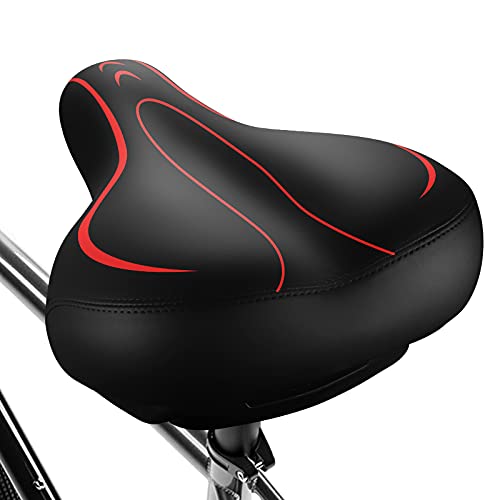
The DR BIKE option in the product list is described as a wide saddle with memory foam, dual springs, and a central ventilation opening. The Schwinn Cruiser Bike Seat, Extra-Wide is described as having soft foam, shock-absorbing elastomers, and a weather-resistant PU cover, with a design intended for upright recreational riding. Those descriptions identify features, not proof that either design will stop a particular rider’s pain.
The SE Bikes Raise It Up Seat listing supplies no useful fit dimensions or detailed construction information beyond its name. That leaves important questions unanswered, including its width, shape, padding, and suitability for a particular rider or posture. Check the seller or manufacturer listing for current specifications before treating it as a fit solution.
Position can change contact and pressure
Saddle height, tilt, and fore-and-aft position influence the rider’s relationship to the pedals and handlebars. A saddle set too high can encourage rocking at the hips, while a position that feels too far forward or back may alter how the rider settles on it. These are possible clues, not a diagnosis, and the appropriate position varies with the bicycle and rider.
Make careful, small adjustments rather than changing several settings at once. Keep the saddle securely installed, and follow the bicycle and component manufacturers’ installation instructions. If you can’t identify the adjustment or the saddle shifts during a ride, have the setup checked before continuing to ride on it.
For a broader look at related seat styles, our overview of mini bike-seat options can help frame a separate product comparison, though a category label cannot replace checking the exact saddle’s fit and specifications. Riders considering a seat for carrying gear can also see our bike-seat guide for commuter use for related context. Neither link establishes a fit recommendation for an individual bicycle.
How to Narrow Down the Cause Without Guessing
Start by returning to a ride duration that doesn’t trigger severe or lingering symptoms. Note the bicycle, saddle, clothing, route, and approximate time when discomfort begins, then make one modest change at a time. This gives you a clearer comparison than simultaneously changing saddle height, tilt, padding, and riding distance.
Check that the saddle is secure and not visibly damaged, then consider whether its shape suits the riding position and whether the current position feels stable. A loosened or damaged saddle needs attention before further fit experiments. Don’t continue riding on a component that appears unsafe or cannot be secured according to its instructions.
Clothing, breaks, and gradual ride increases
Clothing can contribute through seams, bunching, or friction, particularly on longer rides. Cycling shorts designed to reduce rubbing may be worth considering, but they won’t correct a saddle that is poorly matched or positioned. Keep clothing clean and dry, and avoid assuming that extra padding in clothing will suit every rider.
After a break from cycling, build duration gradually rather than jumping straight to a long ride. Rest between rides if soreness has not settled, and avoid using pain as a target to push through. A change in route, terrain, or time in an aggressive posture may also affect how much pressure the saddle receives.
Some riders compare saddle changes with adjustments to bicycle fit or riding position. A useful fitting conversation can account for the whole bicycle rather than focusing on padding alone. If discomfort is recurrent, a qualified bicycle fit professional may help assess setup, while a health professional is appropriate for persistent, severe, or concerning symptoms.
Choosing a Replacement Without Expecting a Cure
If a saddle is worn, damaged, or clearly unsuitable for the riding posture, replacement may be reasonable. Treat the product description as a starting point: confirm dimensions, shape, materials, pressure-relief details, and stated use before buying. The three listed saddles provide limited specifications, so the available descriptions alone cannot determine which one will suit a particular rider.
The Schwinn listing includes a seatpost clamp and mounting hardware and says it is compatible with most standard bicycle seatposts. That is the manufacturer’s stated information, not confirmation for every bicycle. The DR BIKE listing says its mount fits most bikes, but a buyer should still verify the actual mounting arrangement and product instructions. The SE listing lacks sufficient compatibility detail in the supplied information to support a definitive fit statement.
Before purchase, check the saddle’s rail and clamp arrangement against the bicycle’s seatpost head and manufacturer guidance. The supplied descriptions do not provide rail dimensions for these options, so don’t assume that a saddle will attach simply because it is marketed for bicycles. If fit guidance, dimensions, or return terms matter to your decision, confirm them with the seller before ordering.
Price can be one part of the decision, but a low-cost saddle that doesn’t match the intended riding position may not address the problem. Likewise, a feature-rich description cannot promise relief. Prefer clear specifications and a suitable way to verify fit over claims that a wider, softer, or spring-supported design works for everyone.
When the Timeline Calls for More Than Patience
Mild tenderness that resolves and gradually becomes less noticeable is different from pain that escalates, returns quickly on every ride, or lingers after cycling. Numbness, skin injury, significant swelling, or symptoms that interfere with daily activity are reasons to stop and seek appropriate advice rather than waiting for a saddle to break in. A saddle change may be one part of an assessment, not a substitute for care.
If a careful position check and shorter rides do not improve the pattern, review the saddle and bicycle setup with someone qualified to assess fit. Bring notes about the onset, location, duration, and recent setup changes. That detail can help separate a possible saddle issue from posture, clothing, riding load, or another cause.
There is no fixed number of rides after which a bike seat should stop hurting. Mild adjustment may ease with gradual riding, but persistent or worsening discomfort calls for a fit and health-minded reassessment, not simply more time in the saddle. Check position and compatibility carefully, and choose a replacement from verified specifications rather than assuming padding or width will solve the issue.


Write Your Review
No reviews yet. Be the first to share your experience!