


Learning balance while managing motorized acceleration presents real challenges for developing riders and parents alike. Sudden throttle surges or awkward frame sizes can turn an exciting afternoon into a stressful ordeal. A suitable compact electric bike with training wheels 4 setup solves these concerns by pairing low standover frames with predictable speed modes, allowing beginners to build confidence at their own pace. Exploring competitive deals on mini electric bike models reveals that 10-inch and 12-inch wheels keep the center of gravity low and stable.
Motor systems across these beginner rides range from gentle 150W hub motors to youth utility units. Based on manufacturer specifications and customer feedback, manageable speed limiters and responsive brakes matter far more than top speed. Families often review these dimensions against multipurpose electric bike toddlers 1-3 options to verify weight limits and seat heights before buying. A lightweight frame ensures the ride stays manageable whether navigating driveway obstacles or packing the bike into a car trunk.

Pros
- Lightweight 20.06-pound net weight makes handling straightforward for small kids and loading hassle-free for parents
- Push-to-start throttle setup enhances safety by requiring physical momentum before the electric motor activates
- Dual speed settings allow young riders to build riding confidence gradually before reaching the 9 mph maximum speed
- Adjustable saddle from 17.2 to 19.1 inches accommodates standard physical growth for riders aged 3 to 5
Cons
- Manufacturer-listed range of 4.9 miles is modest and will vary depending on rider weight, surface incline, and speed mode
- Front-only V-brake setup requires toddlers to develop hand-grip strength and braking technique on the handlebar lever
- Narrow target window of ages 3 to 5 means taller or older children will outgrow the 19.1-inch maximum saddle height quickly
The Hiboy BK1 Electric Balance Bike is an entry-level motorized trainer specifically scaled for children ages 3 to 5. Unlike full-size commuter models, this compact two-wheeler is built to teach steering, balance, and throttle control in controlled environments such as driveways, paved parks, and suburban sidewalks where permitted. Weighing 20.06 pounds, it provides young children with a grounded, non-intimidating electric riding experience that serves as a bridge between traditional push balance bikes and pedal-driven bicycles.
Propulsion is handled by an electric motor rated at 100W during regular operation with a peak output of 150W. To prevent sudden starts, the bike incorporates a kick-off start mechanism where the child must first push off the ground to glide before the handlebar accelerator responds. The system features dual speed modes with a maximum listed speed of 9 mph, allowing parents to select a conservative pace while their child learns basic control. Energy is supplied by a 21.6V 2.6Ah internal battery that provides a manufacturer-stated range of up to 4.9 miles per charge, though actual distance will depend on riding speed, rider weight, and surface grade.
The physical build of the Hiboy BK1 centers on a low-profile chassis measuring 35.9 by 20.2 by 24.4 inches. Rolling on 12-inch pneumatic tires, the bike absorbs minor sidewalk bumps better than solid plastic toy wheels while maintaining a low center of gravity. Stopping duties are managed by a front V-brake controlled via a handlebar lever, introducing young riders to hand-brake operation early on. In addition, the frame assembly carries an IPX4 water-resistance rating, providing defense against light outdoor puddles and unexpected water splashes.
Daily ownership and usability are straightforward for parents. The saddle adjusts smoothly between 17.2 inches and 19.1 inches from the ground, ensuring proper inseam clearance as toddlers experience growth spurts. Replenishing the 21.6V battery takes approximately 3 to 4 hours using the included charger, making it easy to restore a full charge between morning and afternoon outings. Transport is equally manageable, as the 20.06-pound total weight can easily be lifted with one hand into an SUV hatch or car trunk for park visits.
Buyers should keep practical limitations in mind before purchasing. The listed 4.9-mile range is designed strictly for short play sessions rather than long-distance family treks, and aggressive throttle use in the faster speed mode will deplete the battery more quickly. Furthermore, because it relies on a single front V-brake, parents will need to spend time teaching younger riders how to squeeze the handlebar brake lever effectively rather than instinctively dragging their shoes on the pavement.
For families seeking a durable, low-weight electric balance bike to introduce a 3- to 5-year-old to motorized two-wheel riding, the Hiboy BK1 represents a practical, safety-conscious option. Its kick-to-start operation, modest power envelope, adjustable saddle, and manageable 20.06-pound footprint deliver a sensible learning platform that builds coordination without overwhelming young riders.
The Hiboy BK1 utilizes an electric motor configured for 100W of regular running power with a 150W peak rating. This moderate power profile is tailored specifically for preschool-aged children, providing enough torque to maintain momentum across flat grass and paved surfaces without aggressive acceleration.
Safety is integrated directly into the throttle control through a kick-off start requirement. The rider must manually glide the bike forward using their feet before the accelerator will deliver electric assistance, preventing unintentional throttle twists while standing stationary. With dual selectable speed modes, parents can govern the maximum pace up to 9 mph as the rider gains confidence and steering proficiency.
Power is delivered by a 21.6V 2.6Ah battery integrated into the compact frame. The manufacturer lists a maximum operating range of up to 4.9 miles per full charge, though real-world mileage will fluctuate depending on the child's weight, terrain roughness, incline, and the chosen speed setting.
Recharging the battery requires roughly 3 to 4 hours using standard household power and the supplied charging adapter. The electrical system also features an IPX4 water-resistance rating, helping protect internal electronics from light rain and water splashes during typical outdoor play.
The Hiboy BK1 is engineered to fit children between ages 3 and 5, supported by an adjustable seat that ranges from 17.2 inches to 19.1 inches off the ground. Parents should measure their child's inseam to ensure both feet can plant flat on the ground for secure balance and stopping.
With external dimensions of 35.9 x 20.2 x 24.4 inches and a total weight of 20.06 pounds, the small frame allows young riders to maintain control without being overwhelmed by bike mass. The 12-inch tires keep the overall standover height accessible, allowing young kids to step on and off the bike easily without assistance.

Pros
- UL2272 certified electrical system provides verified battery and charging reliability
- Three capped speed levels (6, 8, and 10 mph) let parents regulate pace as kids build balance
- 12-inch pneumatic tires offer better road comfort and grip than hard solid tires
- Simple rear drum hand brake introduces basic bicycle braking mechanics early
Cons
- Fixed seat design prevents vertical saddle height adjustments as children grow
- Strict 77-pound maximum weight capacity limits usability to early childhood
- Runtime is listed at up to 60 minutes, which can decrease under maximum speed or heavier rider loads
The Gyroor S1 Electric Balance Bike is engineered specifically for active toddlers and young riders aged 3 to 6 who are learning two-wheel coordination. Built as an introductory motorized training platform, this compact ride-on gives early riders an accessible path toward mastering throttle control, steering balance, and hand braking on neighborhood sidewalks or paved park trails.
Propulsion is handled by a 200W rear hub motor paired with an electric throttle for progressive acceleration. To prevent beginners from feeling overwhelmed, the system includes three distinct speed settings capped at 6 mph, 8 mph, and 10 mph. Powered by a 24V 2.5Ah rechargeable battery, the manufacturer lists up to 60 minutes of continuous riding per charge, though actual runtime naturally shifts based on terrain grade, throttle habits, and child weight.
The chassis is constructed from rigid carbon steel, offering a stout structure rated for riders up to 77 pounds. Unlike entry-level kids' toys that rely on hard plastic or solid foam wheels, the Gyroor S1 rides on 12-inch pneumatic rubber tires that absorb sidewalk cracks and small bumps smoothly. Braking is controlled through a dedicated handlebar lever connected to a rear drum brake, providing predictable, contained stopping power.
Setup is straightforward, as the bike arrives 85 percent pre-assembled; parents only need roughly 15 minutes to secure the handlebars and front wheel using the included tools and manual. Added design flair includes a rear fender equipped with a 7-color LED taillight projecting dynamic illumination onto the ground for added visual engagement and dusk visibility during family neighborhood walks.
While feature-packed for preschool and kindergarten riders, the bike features a fixed seat height, which means vertical saddle adjustments are not possible as your child grows taller. Furthermore, with a strict 77-pound maximum payload, the bike is strictly meant for small children and cannot accommodate older elementary-aged siblings.
For parents and gift-givers seeking an approachable, safety-certified first e-bike to develop balance skills, the Gyroor S1 offers a practical combination of regulated power and durable construction. The UL2272 electrical certification, pneumatic tire ride quality, and staged speed caps make it a sensible stepping stone before advancing to pedal bicycles.
Safety certification is a critical consideration for battery-operated youth ride-ons, and the Gyroor S1 features an electrical system certified to UL2272 standards. This listing covers the battery pack and charging system to ensure electrical and fire safety compliance during routine charging and operation.
Mechanical safety is reinforced by the carbon steel frame, which delivers structural rigidity up to the 77-pound payload limit. The rear drum brake setup ensures children learn proper hand-brake modulation without abrupt front-wheel lockups.
The Gyroor S1 provides three selectable speed modes: a slow 6 mph setting for brand-new riders, an 8 mph mode for developing confidence, and a 10 mph top setting for experienced toddlers. This tiered design allows parents to govern the maximum velocity based on their child's motor skills.
The integrated 24V 2.5Ah battery provides a manufacturer-stated runtime of up to 60 minutes of continuous outdoor adventure. Actual operational time will vary based on the active speed mode, the rider's weight, and the slope of the riding surface.

Pros
- Lightweight 20.06 lb total weight helps young children maintain balance and control
- Kick-start throttle system prevents unexpected starts from a standstill
- Seat height adjusts between 17.2 and 19.1 inches to fit growing kids ages 3 to 5
- Quick 3 to 4 hour charging time keeps downtime minimal between neighborhood play sessions
Cons
- Listed range of up to 4.9 miles is limited to short neighborhood or driveway outings
- Relies on a single front V-brake rather than dual-wheel braking systems
- Weight and power limits restrict practical use to small children up to around age 5
The Hiboy BK1 Electric Balance Bike is a compact motorized trainer engineered specifically for children aged 3 to 5 who are developing foundational steering and riding skills. Weighing just 20.06 pounds, this lightweight trainer gives young beginners a manageable platform to transition from foot-powered scooting to assisted cruising without the added complexity of standard pedals.
Powered by a drive system offering 100W in regular mode and reaching up to 150W peak motor output, the bike delivers gentle, predictable acceleration suited for preschool riders. It features dual speed modes with a listed maximum speed of up to 9 mph, allowing parents to align the bike's pace with their child's skill progression. Safety is reinforced by a kick-off start design, requiring the child to glide forward on the ground before the throttle accelerator activates, which effectively prevents unintentional power surges from a complete standstill.
Electrical energy is supplied by an integrated 21.6V 2.6Ah battery that provides a manufacturer-listed range of up to 4.9 miles per charge. Replenishment requires roughly 3 to 4 hours with the standard charging setup. Built with overall dimensions of 35.9 by 20.2 by 24.4 inches, the bike rolls on 12-inch pneumatic-style tires that provide adequate stability on paved driveways, sidewalks, and flat park walkways. An IPX4 water-resistance rating offers practical protection against light surface splashes during everyday play.
Ergonomics and stopping controls are specifically scaled for small hands and developing coordination. The saddle adjusts vertically between 17.2 and 19.1 inches, ensuring that young riders can keep their feet firmly planted on the ground when stopping. Deceleration is handled by a front V-brake connected to an accessible handlebar lever, helping children build muscle memory for bicycle-style hand brakes before transitioning to larger two-wheelers.
While well-conceived for early balance practice, the bike operates within clear performance boundaries. The listed 4.9-mile range is intended for brief recreation rather than prolonged outings, and actual distance will naturally vary based on rider weight, riding speed, and local surface gradient. Furthermore, because stopping power relies on a single front V-brake, close parental supervision remains important while young riders master braking modulation and control.
For families seeking an approachable, well-proportioned training bike, the Hiboy BK1 provides a balanced combination of safety controls, lightweight handling, and adjustable sizing. Its kick-start safety gate and dual speed settings make it a solid introductory option for toddlers learning balance, steering, and throttle discipline.
The Hiboy BK1 features a motor rated at 100W in regular operation with a peak output of 150W. This power profile is tailored to young riders, prioritizing gentle takeoff over abrupt acceleration.
The system incorporates dual speed modes to adapt to different riding environments and skill levels, delivering a top assisted speed of up to 9 mph. A mandatory kick-off start ensures the accelerator only engages after the child manually glides forward, reducing accidental engagement.
Energy is stored in a 21.6V 2.6Ah battery system that delivers up to 4.9 miles on a full charge under typical manufacturer test conditions. Real-world distance may vary depending on the child's weight, terrain surface, and selected speed mode.
Charging the battery pack requires approximately 3 to 4 hours using the standard charger, allowing the bike to be easily refreshed between morning and afternoon play sessions.
Designed for children ages 3 to 5, the Hiboy BK1 offers an adjustable saddle height ranging from 17.2 to 19.1 inches, allowing little riders to maintain proper leg extension while still being able to place both feet flat on the ground.
Stopping power is controlled via a front V-brake with a handlebar-mounted lever sized for small hands, giving toddlers an early introduction to standard hand-brake operation. The bike also carries an IPX4 rating for light splash resistance during outdoor rides.

Pros
- UL2272 certified electrical system adds peace of mind for family charging and storage
- Three progressive speed modes allow toddlers to learn at safe, manageable speeds
- Pneumatic 12-inch tires deliver smoother shock absorption than rigid plastic or solid wheels
- Quick 15-minute assembly with pre-assembled components and included tools
Cons
- Fixed seat design cannot be adjusted vertically as the child grows taller
- Maximum rider weight limit is 77 pounds, strictly restricting use to young children ages 3 to 6
- Weighs 24.25 pounds, which may be heavy for small toddlers to lift without adult assistance
The Gyroor S1 Electric Balance Bike is a motorized entry-level training bike designed specifically for children ages 3 to 6 who are transitioning from basic foot-powered balance bikes to powered riding. Built on a sturdy carbon steel frame with 12-inch wheels, this model combines a classic balance-trainer format with a twist throttle and electric drive. It suits parents seeking a structured way to help young toddlers develop coordination, balance, and throttle discipline in driveway, sidewalk, and neighborhood park settings.
Propulsion is handled by a 200W rear hub motor managed through three switchable speed settings: 6 mph, 8 mph, and 10 mph. This stepped speed configuration allows parents to restrict top velocity while a toddler builds steering confidence before opening up higher speeds. Power comes from a 24V 2.5Ah rechargeable battery pack that provides up to 60 minutes of continuous outdoor riding per charge. Real-world runtime will naturally vary depending on rider weight, riding speed mode, and ground incline. Stopping is handled by a dedicated rear drum brake operated by a handlebar lever, providing predictable braking power without abrupt front-wheel lockups.
In terms of construction, the S1 features a durable carbon steel frame paired with air-filled 12-inch pneumatic rubber tires. These air tires deliver approximately 30 percent better shock absorption than solid rubber or plastic composite wheels, smoothing out expansion joints on sidewalks and gentle bumps on park paths. Safety and evening styling are bolstered by a rear fender LED light that projects seven vibrant colors directly onto the ground. The electrical system holds UL2272 certification, confirming standard-tested battery and charging system design.
Out of the box, the bike arrives 85 percent pre-assembled, requiring roughly 15 minutes of assembly using the included tools and instructions to attach the handlebars and front wheel. Ongoing maintenance centers on checking pneumatic tire air pressure, verifying brake cable tension on the rear drum brake, and routinely recharging the 24V battery using the manufacturer-supplied charger. At 24.25 pounds, the bike has substantial heft for its size, which adds grounded stability during riding but may require a parent to lift it over curbs or load it into a vehicle trunk.
Buyers should keep several realistic design boundaries in mind. The bike utilizes a fixed ergonomic seat design, meaning seat height cannot be raised or lowered to adjust for rapid toddler growth spurts. Additionally, the maximum rider weight limit is capped at 77 pounds, firmly restricting use to young children. While pneumatic tires enhance comfort over paved and packed surfaces, the low ground clearance and modest power output are not built for tall grass, loose dirt, or steep neighborhood hills.
For families looking to introduce a young child to electric two-wheel riding, the Gyroor S1 offers a sensible combination of low-speed limits, pneumatic comfort, and certified electrical safety. Its progressive 3-speed selector and responsive drum brake provide a controlled platform for learning bike fundamentals, making it a reliable training companion for neighborhood rides.
The Gyroor S1 is powered by a 200W rear hub motor designed to deliver smooth acceleration through an electric handlebar throttle. To accommodate developing balance skills, the bike provides three distinct speed settings: a beginner-friendly 6 mph mode, an intermediate 8 mph mode, and a top setting of 10 mph. These graduated options allow parents to limit maximum speed while toddlers learn basic steering and throttle control.
Because power delivery is electric, the motor gives children the feel of powered two-wheel motion without the complexity of pedals or gear shifting. The rear hub motor placement keeps drive components low and centered, assisting with overall balance and straightforward control on paved neighborhood paths.
Electrical safety is anchored by a UL2272 certified electrical system, covering the 24V 2.5Ah rechargeable battery and charging configuration. This certification confirms adherence to recognized electrical and fire-safety standards for personal electric mobility systems, offering reassurance during garage or home charging sessions.
The included battery provides up to 60 minutes of continuous riding per full charge under standard operating conditions. Stopping duties are managed by a reliable rear drum brake, giving young riders direct hand-lever control to bring the 24.25-pound bike to a smooth and controlled stop without sharp front-wheel jarring.
Constructed around a heavy-duty carbon steel frame, the Gyroor S1 supports young riders up to a maximum weight capacity of 77 pounds. The bike measures 20.43 by 23.82 by 38.46 inches and rolls on 12-inch pneumatic tires that cushion impacts across neighborhood sidewalks and asphalt paths better than solid plastic wheels.
The ergonomic saddle features a fixed seat height tailored for children ages 3 to 6, promoting an upright and natural riding posture. Because the seat is non-adjustable, parents should check their child's inseam against standard 12-inch balance bike dimensions to ensure comfortable flat-foot reach to the ground for balance and support.

Pros
- Ultra-compact folding geometry fits into small apartments, closets, and vehicle trunks
- 500W motor paired with a 48V 432Wh battery reaches up to 20 mph for quick urban commutes
- Removable battery pack enables convenient indoor charging without moving the entire bike
- Includes dual disc brakes and integrated front and rear safety lighting out of the box
Cons
- Total bike weight of 52 pounds can be cumbersome to carry up multi-story staircases
- Compact 14-inch wheels transmit road bumps and surface imperfections more readily than standard bike wheels
- Product specifications do not list multi-gear mechanical shifting or specific rider payload capacities
The HQYEX 14-inch mini folding electric bike is engineered as a space-efficient personal mobility option for urban commuters, college students, and apartment dwellers who prioritize compact dimensions. With its miniature frame geometry and folding midsection, this model targets riders who need a practical way to manage short-to-medium city trips while retaining the ability to stow the bike inside a tight hallway, office corner, or car trunk.
Propulsion centers on a 500W brushless motor capable of propelling the bike to a listed top speed of 20 mph. Energy is supplied by an internal 48V 9Ah lithium-ion battery with a 432Wh capacity, delivering a manufacturer-rated travel range between 20 and 40 miles per charge. Real-world distance varies depending on rider weight, throttle usage, hills, wind resistance, and stop-and-go frequency. Riders can switch among three operational modes, including a dedicated throttle mode for motor-only cruising, pedal assist (PAS) to supplement pedaling effort, and a conventional manual pedaling mode when unpowered riding is preferred.
The build relies on a compact frame outfitted with 14-inch wheels, measuring 48 by 20 by 40 inches in its assembled layout. Stopping performance is handled by dual mechanical disc brakes located at both the front and rear wheels, providing dependable deceleration for urban traffic and neighborhood streets. For visibility during early mornings or night rides, the bike comes equipped with an integrated LED headlight and a matching taillight, eliminating the immediate need for third-party lighting accessories.
Daily ownership and storage are simplified by the battery design, which unlatches and removes cleanly from the frame so users can charge it near a standard wall outlet without wheeling the bike indoors. The folding mechanism allows the handlebars and frame to collapse inward for vehicle transport. Routine upkeep involves checking tire pressure on the 14-inch tires, keeping brake cables adjusted, and following standard lithium-ion battery care practices, such as storing the pack at moderate room temperatures.
Riders should consider a few realistic tradeoffs inherent to this design. At a listed product weight of 52 pounds, the bike has noticeable mass despite its small size, which may present a lifting challenge for extended walks up apartment stairs. Additionally, the smaller 14-inch wheel diameter offers less rollover capability over rough pavement, potholes, and gravel than standard 26-inch or 27.5-inch commuter tires, and the product data does not list a multi-speed gear derailleur or formal payload rating.
For city riders and budget-conscious commuters looking for an ultra-compact electric bike with throttle and assist versatility, the HQYEX mini foldable e-bike delivers solid everyday utility. As long as you account for the 52-pound lifting weight and the firmer ride characteristics of 14-inch wheels on imperfect streets, it offers an accessible, space-saving urban transport platform backed by a 1-year manufacturer warranty.
The HQYEX folding e-bike is powered by a 48V 9Ah lithium-ion battery pack rated at 432 watt-hours. The manufacturer lists an expected operating range of 20 to 40 miles per full charge. Riders operating primarily on flat terrain with moderate pedal assist can expect to approach the higher end of that estimate, while continuous throttle riding, steep inclines, colder temperatures, and heavier loads will reduce achievable range toward the lower end.
The battery pack features a removable mounting configuration, allowing riders to detach it with a key for convenient indoor charging at home or at a work desk. To help maintain cell health over time, the battery should be recharged using the original charger and kept away from extreme hot or cold environments during storage.
With full assembled dimensions of 48 by 20 by 40 inches, this electric bike features a folding frame structure designed to minimize footprint inside tight living spaces. The collapsible frame makes it possible to store the bike in a car trunk, slide it into a studio apartment closet, or park it neatly under a workstation between commutes.
While the folding mechanism provides substantial space savings, buyers should factor in the bike weight of 52 pounds when assessing overall portability. The compact 14-inch wheel size makes the folded package easier to tuck away, but lifting the 52-pound chassis into elevated vehicle cargo areas or carrying it across transit stations requires noticeable physical effort.

Pros
- Automatic CVT transmission lets beginners focus completely on balance and throttle management without shifting
- Push-button electric start makes starting fast and manageable for young riders
- Dual 140mm front and rear disc brakes provide consistent, reliable stopping power
- Included removable training wheels assist new riders during initial balance development
- Four-stroke engine runs on standard unleaded gasoline without the need to premix two-stroke oil
Cons
- Assembly is required before first ride, including the handlebar brackets, wheels, brakes, number plate, and fender
- Compact 10-inch wheel size and youth frame dimensions will eventually be outgrown by older or taller kids
- Combustion engine requires regular fluid checks, air filter cleanings, and carburetor maintenance compared to electric mini bikes
The X-PRO Hawk 60cc is an entry-level youth off-road dirt bike designed specifically for children and beginner riders taking their first steps into motorized trail riding. Built around an air-cooled four-stroke 60cc engine and a compact chassis with 10-inch wheels, this youth motorcycle offers an accessible platform for learning balance, steering, and throttle regulation in supervised outdoor environments.
Under the seat, the four-stroke engine avoids the inconvenience of mixing two-stroke oil and gas, running cleanly on standard pump fuel from its 1.6-liter tank. Power delivery is managed through an automatic CVT transmission that requires no manual clutch pull or foot shifting, which significantly reduces the learning curve for young novices. Starting the motorcycle is equally accessible thanks to an integrated push-button electric start that eliminates the physical effort of kick starting.
For handling and stopping control, the Hawk 60cc is equipped with 140mm mechanical disc brakes at both the front and rear wheels. Having dedicated hand levers for both front and rear discs encourages young riders to develop proper braking habits and lever modulation early on. The 10-inch wheel package keeps the overall center of gravity low, allowing new riders to touch the ground comfortably and maneuver across packed dirt, grass, and smooth trails.
Setup and initial learning are made easier by the inclusion of detachable training wheels. These auxiliary wheels bolt onto the rear axle structure, providing physical stability while beginners learn how the throttle and brakes respond. Once the rider gains balance and spatial awareness, the training wheels can be unbolted. Out of the box, parents should expect some mechanical assembly, which includes mounting the handlebar brackets, front wheel, brake components, front fender, and number plate.
Buyers should keep a few realistic limitations in mind before purchasing. Because this is a gas-powered youth motorcycle, ongoing ownership requires basic engine upkeep, such as checking engine oil levels, maintaining chain tension, inspecting tire pressure, and cleaning the air filter. In addition, the compact 10-inch wheels and medium youth proportions mean faster-growing children may size out of the machine after a few seasons of progression.
For families looking to introduce kids to off-road motorcycling with a low-stress, feature-packed starter machine, the X-PRO Hawk 60cc offers dependable value. The combination of an automatic transmission, electric start, dual disc brakes, and included training wheels provides an approachable, confidence-building foundation for young trail enthusiasts.
The X-PRO Hawk 60cc utilizes 140mm disc brakes on both the front and rear wheels to provide dependable, controlled stopping force for youth riders. The dual-disc setup offers responsive lever feedback, allowing small hands to apply smooth, predictable braking without excessive grip effort.
Routine inspection of the brake cables, lever free play, and rotor fasteners helps ensure consistent stopping performance across varied trail conditions, especially after riding through dirt, mud, or dusty terrain.
This starter dirt bike comes equipped with a set of detachable training wheels designed to support young riders during their earliest balance practice. The training wheel setup provides steady ground contact while children learn basic throttle modulation, steering coordination, and braking technique.
As rider balance and confidence improve, the training wheel assembly can be detached with standard hand tools to convert the bike into a traditional two-wheel mini dirt bike. The package also includes the front number plate and fender assemblies required during initial assembly.
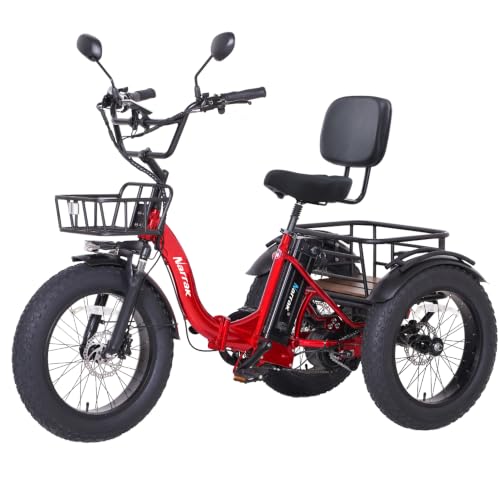
Pros
- Rear differential system allows the rear wheels to turn at independent speeds for smooth, predictable cornering
- Triple-rotor hydraulic disc brakes include a convenient parking lock to prevent rolling while loading cargo
- UL Certified 48V 13Ah removable battery allows convenient off-trike charging at any standard wall outlet
- High-capacity front and rear cargo baskets come standard for practical utility and grocery hauling
- Low-step folding aluminum frame enables easy mounting for riders with knee, hip, or mobility concerns
Cons
- Substantial 130-pound net weight makes lifting into tall vehicles or carrying up stairs difficult without assistance
- Total load capacity is capped at 290 pounds, which must account for both rider weight and all loaded cargo combined
- Wide 31-inch rear axle profile requires extra clearance through narrow gates, doorways, and tight bike paths
The NARRAK Electric Tricycle is a heavy-duty, three-wheeled utility vehicle designed for adults, seniors, and neighborhood riders who prioritize upright stability and cargo hauling over two-wheel agility. Built around a step-through aluminum alloy frame, this trike eliminates the need to swing a leg high over a top tube, offering a confidence-inspiring mount and dismount. It targets riders seeking a dependable platform for grocery shopping, community cruising, or low-stress outdoor recreation where balancing a standard bicycle is challenging or undesirable.
Propulsion is handled by a 750-watt rear central motor capable of delivering up to 1350 watts of peak power, paired with a rear mechanical differential. Unlike rigid single-axle trikes that tend to skip tires or resist turning, this differential allows each rear wheel to rotate at independent speeds, smoothing out turns and improving directional control. Power is supplied by a removable UL Certified 48V 13Ah battery pack that provides a manufacturer-rated range of up to 50 miles per charge under pedal-assist operation. Riders can tailor their effort using the handlebar-mounted Narrak LCD M5 display, which controls the pedal-assist levels, full-electric throttle mode, and a dedicated walk-assist setting.
Component selection emphasizes safety and practical utility throughout the build. The trike features 20-inch by 4-inch fat tires that provide a broad footprint across asphalt, brick pavers, and hard-packed gravel trails. Braking is managed by three disc rotors clamped by hydraulic calipers, providing balanced stopping power across all three wheels. An integrated hydraulic parking brake lever locks the system in place, ensuring the trike remains stationary when parked on inclines or while loading heavy items into the baskets.
Daily ownership and maintenance are straightforward, with the trike shipping roughly 85 percent pre-assembled alongside essential assembly tools and instructions. The frame features a central folding hinge that collapses the structure to help manage its generous 72 by 31 by 51-inch operational footprint. Because the complete trike weighs 130 pounds, lifting it into an SUV or truck bed requires two people or a loading ramp. The removable battery pack eases charging routines, allowing riders to leave the heavy trike in the garage while bringing the power pack indoors to recharge.
Shoppers must keep key physical limitations in mind when assessing this model. While the aluminum frame is robust, the maximum weight capacity is rated at 290 pounds. This limit encompasses the rider, riding gear, and all cargo carried inside both the front and rear baskets. Additionally, the 31-inch rear width demands extra care when steering through narrow yard gates, commercial entryways, or tight urban infrastructure.
The NARRAK 750W Electric Tricycle represents a well-rounded option for riders who need the physical stability of three wheels and the utility of high-volume cargo baskets. Its rear differential, hydraulic disc brakes, and wide fat tires deliver a stable, comfortable ride on neighborhood streets, provided your total payload fits within the 290-pound limit and you have appropriate ground-level storage for its 130-pound frame.
The NARRAK e-trike is driven by a 750-watt rear central motor with a peak rating of 1350 watts, delivering sustained power to move a fully loaded three-wheeler. A primary mechanical advantage is its integrated rear differential system. Traditional solid-axle trikes often scrub tires or feel unstable when turning because both wheels are forced to rotate at identical speeds. The NARRAK differential enables the outer rear wheel to turn faster than the inner wheel during cornering, promoting natural steering and predictable handling.
Riders can switch among pure throttle power, multiple pedal-assist settings, and a walk mode via the backlit LCD M5 console. The display keeps real-time speed, trip distance, and battery level clearly visible. As with all electric powertrains, actual power delivery and range will fluctuate based on rider weight, cargo load, wind resistance, and road grade.
Stopping a heavy three-wheeled vehicle requires balanced brake distribution, which NARRAK accomplishes through hydraulic disc brakes across three dedicated rotors. Hydraulic fluid actuation ensures consistent pressure at all three wheels with less hand fatigue compared to traditional mechanical cable systems.
An essential safety feature is the hydraulic parking brake system. By locking the brake lever in position, the trike remains completely stationary on inclines, preventing accidental rollaways while parking or loading groceries into the rear utility basket.
Utility is central to the NARRAK design, which features both a front basket and an upgraded extra-large rear basket. These open metal baskets accommodate daily essentials, shopping bags, pet carriers, or gardening supplies for neighborhood tasks.
The total weight limit for the trike is 290 pounds. This rating includes the combined weight of the rider and all cargo placed in the front and rear compartments. To preserve stability and frame longevity, riders should distribute heavier items toward the bottom of the rear basket and verify that total payload remains within manufacturer guidelines.
Frequently Asked Questions
How do speed modes help beginners ride a Compact Electric Bike With Training Wheels 4 safely?
Selectable speed limits allow young riders to master balance and braking before handling higher velocities. Multi-speed settings typically start near 6 mph and increase to 10 mph. This gradual pace prevents sudden throttle surprises while motor control develops.
Are training wheels removable as riding skills develop?
Yes, detachable training wheels can be removed once a rider gains balance and steering coordination. Youth off-road bikes and mini motorized trainers use standard bolt-on brackets. This modular design helps the bike transition into a regular two-wheel ride easily.
How much assembly is required out of the box?
Most compact bikes arrive approximately 85 percent pre-assembled from the manufacturer. Setup usually involves attaching the handlebars, front wheel, foot pegs, and training wheels. Reviewing electric bike easy assembly processes helps ensure hardware is tightened properly before the first ride.
What battery runtime can parents expect from junior e-bikes?
Continuous riding time typically ranges from 45 to 60 minutes per charge on 21.6V or 24V batteries. Total range spans roughly 4 to 5 miles under smooth throttle use. Grass surfaces, rider weight, and frequent stops can reduce total operating time.
How does seat adjustability improve rider stability?
Adjustable seat heights ensure young riders can plant both feet flat on the ground during stops. Quick ground contact builds confidence and prevents awkward tipping on uneven driveways. While adults look for relaxed frames like zen comfort electric bike designs, children require proper standover clearance above all else.




Write Your Review
No reviews yet. Be the first to share your experience!