


Keeping an electric bike ready to ride is mostly a battery and charger compatibility question, but a solar trickle charger designed for a car battery is not automatically an e-bike charger. The Sunway Solar Car Battery Trickle Charger is described as a 12V battery maintainer with a solar panel rated up to 1.8W, not as an e-bike battery charger. That distinction matters: an e-bike battery and its charging system must be matched to the bike manufacturer’s specifications, and the information supplied for this product does not establish that match. The phrase what is a good electric bike with solar trickle charger therefore needs a careful answer: choose the bike and its approved charging system separately, and consider this Sunway product only for a confirmed, suitable 12V battery application.
Buyers comparing a complete electric bike can start with the intended riding, fit, battery details, and the charger supplied or specified for that model. Our Kamingo commuter e-bike guide and Vivi electric bike options offer related context for comparing bikes, but neither link establishes compatibility with a solar maintainer. For this accessory, the useful questions are narrower: what battery will it connect to, how will it connect, and does the battery manufacturer permit this charging method? The product listing identifies a cigarette-lighter adapter and battery clamps, so the intended connection must be checked rather than assumed.
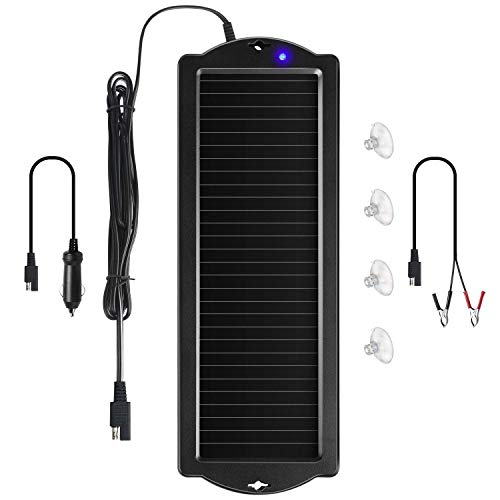
What a solar trickle charger can and cannot do for an e-bike
The Sunway Solar Car Battery Trickle Charger is a solar maintainer for listed 12V batteries, not a documented charger for an electric-bike traction battery. Its product information lists a solar panel output of up to 1.8W, a cigarette-lighter adapter, battery clamps, a blocking diode, and a blinking charge indicator. Those details may suit a compatible 12V battery that needs maintenance, but they do not identify an e-bike battery voltage, connector, charging current, charging protocol, or approval. Without those details, it would be misleading to call the unit a suitable solar charger for an e-bike battery.
The term “trickle charger” can describe a device intended to maintain a battery rather than rapidly replenish a depleted one. Here, the manufacturer describes the Sunway panel as helping keep 12V batteries topped up and states that it will not overcharge the battery. Those are product claims about the intended 12V application, not evidence that it can safely charge every battery or that it can charge an e-bike pack. Battery chemistry and management electronics are not specified in the supplied product details, so buyers should not infer them.
Separate the bike battery from any auxiliary 12V battery
An electric bike’s main battery supplies the drive system, while an auxiliary 12V battery, if present in a separate setup, is a different component with its own requirements. The Sunway listing names cars, motorcycles, boats, RVs, and other 12V battery applications; it does not name e-bike traction batteries. A product category mention, such as motorcycles or recreational vehicles, cannot be expanded into proof of compatibility with an e-bike pack. Confirm the identity and specifications of the exact battery before considering any charging accessory.
Voltage alone would not settle the question even if a battery label showed a familiar number. The charger must also be appropriate for the battery chemistry and charging system, and its connector and electrical characteristics must match the manufacturer’s requirements. The Sunway information supplied here does not give e-bike-specific charging details that could establish those conditions. Do not modify a connector, attach the clamps to an e-bike pack, or use an adapter to make an unverified connection.
For the bike itself, use the charger and charging instructions specified by its manufacturer. If a bike maker offers an approved solar charging arrangement, check that arrangement’s stated voltage, current, connector, and system requirements against the exact bike and battery model. If those details are missing or unclear, ask the bike or battery manufacturer before buying an accessory. A solar panel being able to produce electricity does not, by itself, make it an appropriate charger for a particular e-bike.
What the Sunway product’s listed features mean
The product description says the panel produces up to 1.8W and uses an amorphous solar panel that the manufacturer says works on cloudy days. That is a description of the panel, not a promised charging time, energy yield, or e-bike riding range. No e-bike battery capacity or charging-time information is supplied, and the product data does not state how much energy a particular user would collect in a given location or weather. Treat “up to” as the stated maximum panel output, not a measurement of constant output in every condition.
The listed mounting approach uses suction cups to position the panel on a vehicle windshield or dash, with a cigarette-lighter plug for connection. The listing also mentions battery clamps, which can provide a different connection option for a compatible battery. These connection choices are part of the described 12V product; they do not establish that an e-bike has a matching socket or that its battery maker permits charging through one. Check the device and battery documentation before using either connection method.
The built-in blocking diode is described as preventing reverse charging, and a blinking LED indicates charging according to the product information. These are useful details for understanding the listed design, but they do not replace checking battery compatibility or following its charging guidance. The plastic housing and PV glass are also described by the manufacturer, but the supplied information does not state an environmental rating. Do not interpret those materials as proof that the panel or its connections are waterproof or suitable for exposed outdoor installation.
The manufacturer presents the maintainer for rechargeable 12V batteries in vehicles and marine applications. That broad list still has limits: buyers should verify the battery’s voltage, condition, connection method, and maker’s permitted charging practices. The listing says the unit can help manage battery drain in all seasons, but it does not provide a quantified result or a guaranteed maintenance outcome. For an e-bike owner, the main point remains that the stated 12V application is not an e-bike battery compatibility specification.
How to decide whether it belongs in your setup
Start by identifying the exact battery you want to maintain. Read its label and documentation for nominal voltage, battery type, approved charging method, and any restrictions on unattended charging or storage. Then compare those requirements with the Sunway product information and confirm the connection method is allowed. If the battery is an e-bike traction battery and its maker does not explicitly approve this accessory, do not treat the panel as a substitute for the supplied charger.
Next, identify the job you expect the solar panel to perform. Maintaining a compatible 12V vehicle battery while that vehicle is stored is different from recharging an e-bike after a ride or extending its riding range. The product listing supports the former type of use for 12V batteries, subject to the battery maker’s instructions; it does not specify an e-bike charging function. Being clear about the task prevents a buyer from purchasing an accessory that looks relevant but does not address the actual battery system.
Check the intended physical location and connection before relying on the included accessories. The listing mentions a cigarette-lighter adapter, clamps, and suction cups, but a particular vehicle’s socket and the battery’s terminal arrangement still need to be suitable. If the unit will be placed on a dashboard or windshield, consider whether the position is permitted by the vehicle maker and whether it remains secure without obstructing the driver’s view. The product details do not provide a mounting dimension or a universal vehicle-fit guarantee.
Finally, look for information that is absent, not just features that are present. The supplied description does not provide a charging time, a detailed output-current specification, an e-bike connector, an e-bike battery protocol, or a solar charging system approval from a bike maker. Those gaps mean an e-bike owner cannot make a reliable compatibility decision from the accessory listing alone. If a seller or manufacturer cannot confirm the exact battery application, choose the bike maker’s specified charging solution instead.
Why solar trickle maintenance is not a range upgrade
A solar maintainer should not be described as increasing an e-bike’s listed range unless the bike maker supplies a compatible charging system and substantiates that use. Range depends on the bike battery and riding conditions, and the Sunway listing contains no e-bike range claim. The panel’s stated output of up to 1.8W cannot be converted into a reliable number of miles without battery and operating information that is not provided. A buyer seeking more riding distance should compare the bike maker’s battery specifications and charging options rather than equating a solar accessory with extra range.
Even when a bike manufacturer supports a solar charging option, the panel, controller, battery, and connector need to form an approved system. A connector that physically fits does not demonstrate correct voltage, current, polarity, or communication between components. A nominal voltage match alone would not prove that a charger is suitable either. Keep the bike’s original charging instructions as the reference point and seek written compatibility guidance for any alternative arrangement.
Storage and charging are also separate ownership decisions. A solar maintainer for a compatible 12V battery may be relevant to a vehicle or auxiliary battery kept in storage, but the Sunway product data does not provide e-bike battery storage instructions. Follow the e-bike manufacturer’s guidance for the traction battery, including its charging and storage recommendations. Do not leave a battery connected to an unapproved device simply because the device is marketed as a maintainer.
For riders still comparing complete bikes, the relevant questions are whether the bike has a clearly specified battery, a manufacturer-supported charger, and a practical charging routine for its intended use. A Trailmaster electric bike overview can provide another starting point for bike research, while the electric bike replacement tire guide covers a separate ownership consideration. Neither guide establishes that this solar maintainer works with a particular bike; confirm charging compatibility with the bike manufacturer.
Questions to resolve before connecting any charger
Ask whether the battery is a 12V auxiliary battery or the e-bike’s main traction battery, and whether its manufacturer lists this exact charging method as acceptable. Confirm the required charger output and connector from the battery documentation, rather than relying on a plug that appears to fit. Check whether the battery maker imposes conditions on charging location, supervision, temperature, or storage. If any necessary specification is unavailable, pause and contact the relevant manufacturer.
Also consider what the product description does not establish. It does not identify a particular e-bike brand or model as compatible, state that it charges an e-bike battery, list a charging protocol, or give an e-bike system certification. It does not quantify how quickly a battery can be maintained or how much energy the panel produces in a specific environment. Leaving those points unresolved is more accurate than assuming that a generic solar panel can serve as a universal e-bike accessory.
If the intended battery is a separate 12V vehicle battery, the Sunway listing offers relevant connection and panel details for evaluating that use, but the battery maker’s instructions still govern. If the intended battery is the e-bike’s main pack, use only a charging setup the bike or battery manufacturer approves. Never open a battery pack, bypass its protective electronics, splice connectors, or improvise a connection to make the accessory work. Electrical or battery concerns that are not covered by the manufacturer’s guidance warrant help from the appropriate service provider.
For a complete electric bike purchase, solar charging should be treated as a model-specific system question, not an assumed feature of any bike that has a rechargeable battery. Compare the bike’s published battery and charging specifications, then confirm any solar option directly with the manufacturer. The Sunway Solar Car Battery Trickle Charger is documented as a 12V maintainer, so the available information supports considering it for a suitable 12V battery, not recommending it for an e-bike traction battery. That distinction is the practical answer: verify the exact battery and approved charging method before connecting anything.


Write Your Review
No reviews yet. Be the first to share your experience!