


Fit, controls, and bike type all shape the right pick
A bike that looks like a bargain can still be frustrating if your child can’t comfortably reach the ground or operate its controls. Start with the manufacturer’s stated rider height or age guidance, then check the seat adjustment, wheel size, and listed bike weight where available. Age is a useful starting point, but children of the same age can have different proportions and confidence levels. Those details matter as much as the style of bike when you compare the best cheap kids bike options.
This selection spans no-pedal balance bikes, beginner pedal bikes with training wheels, and electric models, so the products don’t all serve the same purpose. For example, the SEREED lists adjustable seat and handlebar heights, while the Schwinn Elm gives a rider-height range of 47 to 53 inches and combines a coaster brake with a hand brake. The listed information doesn’t provide user review counts, so this comparison sticks to stated specifications rather than implying hands-on results. If your budget is a key factor, compare these options with the kids’ bike picks under 70 dollars, and see another young-rider bike roundup for additional context.

Pros
- Low 8 mph top speed and scaled proportions provide a gentle learning curve for beginners ages 5 and up
- High and low speed switch allows parents to restrict speed while riders build basic balance and throttle control
- Pneumatic tires on 12-inch spoked wheels offer genuine traction and cushioning over grass and pavement
- Up to 80 minutes of continuous ride time in low-speed mode supports long backyard play sessions
- Manageable 29.7-pound overall weight makes vehicle transport and garage storage painless for parents
Cons
- The 8 mph top speed and low frame height will quickly feel undersized for older or taller children
- Sealed lead-acid battery technology is heavier and takes longer to charge than modern lithium alternatives
- Continuous riding time decreases when operating predominantly in the higher 8 mph speed setting
The Razor Dirt Rocket MX125 stands as the brand's smallest electric dirt bike, scaled down specifically to introduce children ages five and up to two-wheeled motorized fun. Built with beginner-friendly proportions, this youth electric ride-on provides a gentle transition from standard pedal or balance bikes to motorized riding in backyards, driveways, and suburban cul-de-sacs. Parents looking for an approachable, low-stress introduction to off-road style riding will find its controlled speed and compact dimensions well matched for younger elementary-aged kids.
Power delivery is tuned for safety and learning, offering a default maximum speed of up to 8 mph (13 km/h) in its high setting. A built-in high/low speed control switch allows caregivers to limit top velocity for newer riders who are still building steering and balancing confidence. Powered by a 12V sealed lead-acid rechargeable battery system, the MX125 provides up to 80 minutes of continuous riding on a single charge when operated in low-speed mode. Stopping duties are handled by a hand-operated rear brake lever on the handlebar, giving young riders familiar bicycle-style braking control to halt safely.
Despite its toy-category classification, the MX125 adopts genuine motorcycle elements such as 12-inch spoked wheels and air-filled pneumatic tires that cushion uneven lawn surfaces far better than hard plastic wheels. The cockpit features a crossbar-reinforced handlebar that enhances steering rigidity and provides classic motocross aesthetics. Additional hardware includes a practical retractable kickstand for upright parking, alongside a durable blue fairing shell designed to handle minor scrapes and regular yard play.
Daily handling and garage storage are straightforward thanks to the bike's compact footprint measuring 36.42 inches long, 21.46 inches wide, and 25.16 inches tall. At an overall weight of 29.7 pounds, an adult can easily lift the bike into an SUV trunk, carry it down patio steps, or tuck it alongside adult commuter bicycles in a garage. Routine maintenance primarily revolves around checking tire pressure in the pneumatic tires, recharging the 12V sealed battery according to manufacturer guidelines, and making sure the rear hand-brake cable remains properly tensioned.
Practical limitations center around rider growth and battery chemistry. With an 8 mph top speed and a low seat stance, taller or more adventurous children will likely outgrow the performance envelope within a season or two. Additionally, sealed lead-acid batteries are noticeably heavier relative to their energy capacity and typically require longer recharge cycles than modern lithium-ion packs, meaning playtime between charges requires advance planning.
For parents and families seeking a safe, manageable first motorized ride-on for young children, the Razor Dirt Rocket MX125 offers solid beginner value. Its combination of pneumatic tires, dual-speed governor, and lightweight 29.7-pound frame creates a confidence-inspiring foundation for kids learning throttle and brake coordination without overwhelming them with excess speed or bulk.
The Razor Dirt Rocket MX125 features a dual-mode speed setup designed to match a child's developing riding skills. In its default high setting, the electric motor propels the bike up to 8 mph (13 km/h), while the onboard high/low toggle switch allows supervisors to dial back maximum speed for beginners. Steering is anchored by a sturdy crossbar-reinforced handlebar, and stopping is regulated via an accessible hand-operated rear brake lever.
Equipped with a rechargeable 12V sealed lead-acid battery, the MX125 is engineered for extended play sessions. Razor lists up to 80 minutes of continuous runtime on a single charge when operating in the low-speed setting. As with all electric ride-ons, real-world runtime will vary depending on rider weight, terrain surface such as grass versus smooth pavement, and whether the bike is run continuously in high-speed mode.
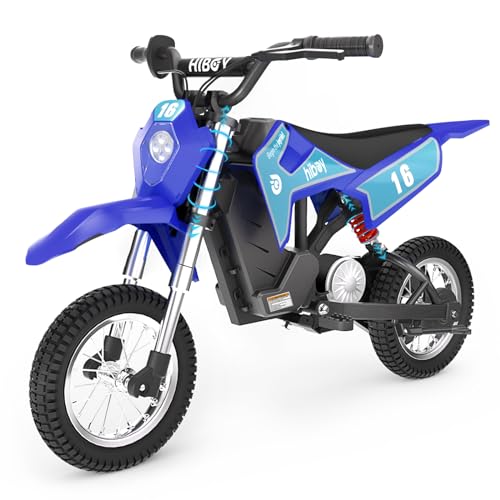
Pros
- Selectable 5.0 mph, 7.5 mph, and 15.5 mph speed settings provide parents with built-in speed management for beginners
- Hydraulic front fork combined with a rear spring shock dampens trail vibration better than rigid youth frames
- Lightweight 38.1-pound design is easy for adults to lift, load into a vehicle, or store upright
- Quiet electric motor operation allows children to ride in residential yards without disturbing neighbors
Cons
- Listed 90-minute battery runtime will decrease when operating continuously at the 15.5 mph top speed or near the 140-pound payload limit
- Features purely motorized throttle drive with no bicycle pedals, leaving no manual propulsion option if the battery runs empty
- Not sized or designed for teenage or adult riders
The Hiboy DK1 is an entry-level youth electric dirt bike engineered specifically for children aged 3 to 10 exploring off-road riding. Designed with authentic dirt bike frame geometry, this model delivers an accessible riding experience for backyards, private trails, and open fields. With a manufacturer-listed rider weight capacity of up to 140 pounds and a light 38.1-pound curb weight, it provides a manageable, confidence-building platform for young riders transitioning to motorized two-wheelers.
Propulsion is handled by a 300W electric motor paired with a rechargeable 36V sealed lithium battery system. To help parents manage safety while their child learns balance and throttle control, the bike features three distinct speed modes: Low at 5.0 mph, Medium at 7.5 mph, and High at 15.5 mph. According to manufacturer data, the battery provides up to 90 minutes of continuous runtime when tested under benchmark conditions with an 88.2-pound rider cruising at 9.3 mph. Fully replenishing the sealed lithium pack takes between 4 and 5 hours using the standard charger.
Chassis construction centers on a dual-suspension configuration intended to absorb rough outdoor surfaces. Up front, a hydraulic shock fork takes the impact out of ruts and sudden elevation changes, while a heavy-duty rear spring shock stabilizes the chassis over uneven grass and hard-packed dirt. This suspension setup reduces riding clatter, making the DK1 notably quieter than traditional small-displacement gas motorbikes. The overall footprint measures 44.3 inches long, 21.7 inches wide, and 29.1 inches tall, giving it realistic mini-moto proportions.
Ownership and transport are straightforward due to the compact dimensions and sub-40-pound overall weight. Parents can readily lift the bike into an SUV cargo area or trunk for family excursions to the park or campsite without requiring a dedicated trailer. Going electric also removes the messy maintenance of gas-powered toys, such as mixing oil, replacing air filters, or tuning small carburetors. Routine upkeep primarily entails keeping the frame clean, inspecting tire condition, checking hardware tension, and maintaining battery charge.
Realistic limitations must be kept in mind regarding battery life and rider sizing. Operating consistently in the top 15.5 mph setting, climbing slopes, or carrying a rider approaching the 140-pound maximum limit will drain the battery faster than the benchmarked 90 minutes. Additionally, because the DK1 is a dedicated throttle-driven mini bike without pedals, young riders cannot pedal back home if the charge is exhausted during a ride.
For families seeking a durable, low-maintenance introduction to off-road riding, the Hiboy DK1 is a dependable choice. Its combination of tiered speed governance, authentic hydraulic suspension, and quiet electric power makes it well-suited for young beginners building riding fundamentals.
The Hiboy DK1 features three preset speed tiers to accommodate children at various stages of motor skill development. The Low setting caps top speed at 5.0 mph (8 km/h), providing an ultra-controlled environment for beginners and younger kids learning throttle modulation. The Medium setting allows speeds up to 7.5 mph (12 km/h), which is well-suited for cruising open grass or gentle dirt paths. The High mode unlocks the full 15.5 mph (25 km/h) capability for older, experienced riders.
Having governed speed settings built into the controller allows parents to tailor performance directly without needing mechanical throttle stops. Because riding dynamics change considerably at 15.5 mph, wearing proper safety gear such as an approved helmet, eye protection, and gloves is essential across all speed levels.
Power is supplied by an integrated 36V sealed lithium battery system engineered for steady energy delivery. Manufacturer testing benchmarks the system at up to 90 minutes of runtime when supporting an 88.2-pound rider at a constant speed of 9.3 mph. In real-world recreational use, runtime will fluctuate based on rider weight, ground resistance, incline, and frequent acceleration.
Charging the battery from depleted to full takes approximately 4 to 5 hours using the included charger. Following standard lithium battery care, the bike should be charged indoors or in a dry environment and kept away from extreme sub-freezing or excessively hot storage areas to preserve cell health over multiple seasons.
The chassis of the Hiboy DK1 incorporates a hydraulic shock fork in the front and a high-strength shock-absorbing spring in the rear. This arrangement softens impacts on bumpy lawns, gravel trails, and dirt tracks, reducing hand fatigue and improving tire contact with the ground for better steering control. The hydraulic dampening also ensures quiet operation without the metallic clatter common to un-dampened youth bikes.
The overall frame geometry reflects standard dirt-bike styling with a total weight of 38.1 pounds and exterior dimensions of 44.3 by 21.7 by 29.1 inches. Designed to support riders up to 140 pounds (64 kg), the frame provides ample structural integrity to accommodate growing kids throughout the recommended 3 to 10 age range.

Pros
- Lightweight 7.8-pound design makes steering easy for toddlers and transport simple for parents
- Tool-free quick-release levers make adjusting handlebar and seat heights fast and simple
- Solid EVA foam tires will never puncture, lose air pressure, or scratch household floors
- Sturdy carbon steel frame supports up to 110 pounds for solid long-term stability
Cons
- EVA foam tires provide less traction on loose gravel or wet surfaces compared to pneumatic rubber tires
- Lacks hand brakes, requiring toddlers to rely entirely on foot braking to slow down and stop
- Sizing is specifically tailored for early toddlers ages two to three, which older or taller children will quickly outgrow
The SEREED Toddler Balance Bike is an entry-level, non-motorized training bicycle engineered specifically for children aged two to three years old. Designed for cycling-focused families and active parents introducing youngsters to two-wheel riding, this pedal-less trainer emphasizes balance, steering coordination, and self-confidence before children transition to traditional pedal bikes or family trail rides.
Operating without pedals, chains, or training wheels, the bike relies on a push-and-glide movement that teaches essential cycling motor skills. A broad integrated footrest pad gives toddlers a dedicated surface to rest their feet once they build gliding momentum. Handling remains intuitive thanks to non-slip rubber grips, an accessible starting seat height of 12.6 inches, and a low center of gravity that helps young riders step on and off independently.
The bike is built around a wide carbon steel frame capable of supporting rider loads up to 110 pounds. Rolling duty is handled by puncture-proof EVA foam airless tires that never require inflation, checking air pressure, or tube patching. These solid tires run quietly across hard floors without leaving scuff marks, allowing youngsters to ride indoors during bad weather as well as across paved driveways and smooth park walkways.
Daily usability is supported by tool-free quick-release clamps on both the saddle and handlebar stems. Parents can raise the seat from 12.6 inches to 17.1 inches and the handlebars from 19.6 inches to 22.5 inches in seconds as children grow. Weighing just 7.8 pounds (3.5 kg) with overall dimensions of 32.28 by 14.95 by 22.44 inches, the bike fits easily into standard vehicle trunks or backseat footwells for park trips, family vacations, or storage in compact apartments.
While the EVA airless tires remove puncture worries, they do not offer the shock absorption or wet-weather grip of traditional pneumatic rubber tires on loose gravel, dirt paths, or damp grass. Furthermore, the absence of hand brakes means stopping depends entirely on the child dragging their shoes on the ground, requiring parental supervision near downhills or busy areas.
For parents, grandparents, and cycling enthusiasts looking for a budget-conscious, durable first bike to teach early balance fundamentals, the SEREED Balance Bike offers exceptional utility. Its sturdy carbon steel construction, tool-free adjustability, and floor-safe puncture-proof wheels make it a dependable gift for young learners preparing for future cycling adventures.
The SEREED Balance Bike features tool-free quick-release clamps that allow rapid height modifications as young riders grow. The saddle adjusts between 12.6 inches and 17.1 inches from the ground, accommodating toddlers with inseams starting at approximately 12.5 inches.
Handlebar height can be raised or lowered from 19.6 inches to 22.5 inches to ensure proper reach and ergonomic arm alignment. These combined adjustments help maintain an upright riding posture tailored specifically for boys and girls between two and three years of age.
Equipped with solid EVA foam airless tires, this bike eliminates the regular maintenance associated with pneumatic bicycle tires. Parents will not need a bicycle pump, tire pressure gauge, or patch kit, as the tires are completely puncture-proof and flat-free.
The tread pattern is engineered to be anti-slip and non-marking, making it quiet and safe on hardwood or tile flooring for indoor practice during cold months. Outdoor riding is best suited for dry pavement, asphalt, and concrete walkways, as solid foam provides firmer feedback than air-filled rubber.

Pros
- Lightweight 20.06 lb total weight helps young children maintain balance and control
- Kick-start throttle system prevents unexpected starts from a standstill
- Seat height adjusts between 17.2 and 19.1 inches to fit growing kids ages 3 to 5
- Quick 3 to 4 hour charging time keeps downtime minimal between neighborhood play sessions
Cons
- Listed range of up to 4.9 miles is limited to short neighborhood or driveway outings
- Relies on a single front V-brake rather than dual-wheel braking systems
- Weight and power limits restrict practical use to small children up to around age 5
The Hiboy BK1 Electric Balance Bike is a compact motorized trainer engineered specifically for children aged 3 to 5 who are developing foundational steering and riding skills. Weighing just 20.06 pounds, this lightweight trainer gives young beginners a manageable platform to transition from foot-powered scooting to assisted cruising without the added complexity of standard pedals.
Powered by a drive system offering 100W in regular mode and reaching up to 150W peak motor output, the bike delivers gentle, predictable acceleration suited for preschool riders. It features dual speed modes with a listed maximum speed of up to 9 mph, allowing parents to align the bike's pace with their child's skill progression. Safety is reinforced by a kick-off start design, requiring the child to glide forward on the ground before the throttle accelerator activates, which effectively prevents unintentional power surges from a complete standstill.
Electrical energy is supplied by an integrated 21.6V 2.6Ah battery that provides a manufacturer-listed range of up to 4.9 miles per charge. Replenishment requires roughly 3 to 4 hours with the standard charging setup. Built with overall dimensions of 35.9 by 20.2 by 24.4 inches, the bike rolls on 12-inch pneumatic-style tires that provide adequate stability on paved driveways, sidewalks, and flat park walkways. An IPX4 water-resistance rating offers practical protection against light surface splashes during everyday play.
Ergonomics and stopping controls are specifically scaled for small hands and developing coordination. The saddle adjusts vertically between 17.2 and 19.1 inches, ensuring that young riders can keep their feet firmly planted on the ground when stopping. Deceleration is handled by a front V-brake connected to an accessible handlebar lever, helping children build muscle memory for bicycle-style hand brakes before transitioning to larger two-wheelers.
While well-conceived for early balance practice, the bike operates within clear performance boundaries. The listed 4.9-mile range is intended for brief recreation rather than prolonged outings, and actual distance will naturally vary based on rider weight, riding speed, and local surface gradient. Furthermore, because stopping power relies on a single front V-brake, close parental supervision remains important while young riders master braking modulation and control.
For families seeking an approachable, well-proportioned training bike, the Hiboy BK1 provides a balanced combination of safety controls, lightweight handling, and adjustable sizing. Its kick-start safety gate and dual speed settings make it a solid introductory option for toddlers learning balance, steering, and throttle discipline.
The Hiboy BK1 features a motor rated at 100W in regular operation with a peak output of 150W. This power profile is tailored to young riders, prioritizing gentle takeoff over abrupt acceleration.
The system incorporates dual speed modes to adapt to different riding environments and skill levels, delivering a top assisted speed of up to 9 mph. A mandatory kick-off start ensures the accelerator only engages after the child manually glides forward, reducing accidental engagement.
Energy is stored in a 21.6V 2.6Ah battery system that delivers up to 4.9 miles on a full charge under typical manufacturer test conditions. Real-world distance may vary depending on the child's weight, terrain surface, and selected speed mode.
Charging the battery pack requires approximately 3 to 4 hours using the standard charger, allowing the bike to be easily refreshed between morning and afternoon play sessions.
Designed for children ages 3 to 5, the Hiboy BK1 offers an adjustable saddle height ranging from 17.2 to 19.1 inches, allowing little riders to maintain proper leg extension while still being able to place both feet flat on the ground.
Stopping power is controlled via a front V-brake with a handlebar-mounted lever sized for small hands, giving toddlers an early introduction to standard hand-brake operation. The bike also carries an IPX4 rating for light splash resistance during outdoor rides.


Pros
- Versatile 6-in-1 design transitions across four years of early motor development (18 to 60 months)
- Lightweight aluminum alloy frame with a one-touch folding button makes vehicle transport simple
- Maintenance-free 12-inch puncture-proof rubber tires remove the hassle of tire pressure upkeep
- Chain-free enclosed gear drivetrain improves child safety and prevents messy chain grease
- Comes complete with removable training wheels, detachable pedals, a kickstand, and a guide handle
Cons
- Manual unpowered design does not offer electric assist, relying on parent pushing or child pedaling
- Upper age limit of 60 months means children will outgrow the cockpit as they enter school age
- Solid rubber tires provide firm feedback over rough gravel compared to pneumatic air tires
The JMMD 6-in-1 Toddler Bike is a convertible multi-stage training bicycle engineered for children aged 18 to 60 months. Tailored for active families, suburban strolls, and park outings, this modular trainer functions as a parent-guided stroller trike, self-propelled tricycle, balance bike, and standard pedal cycle. It gives cycling parents a unified, space-saving learning platform that avoids the expense and clutter of purchasing separate ride-on toys across early childhood.
Day-to-day usability focuses on developmental milestones and smooth parent supervision. When used in guided push mode, the height-adjustable parent handle rotates up to 135 degrees, giving caregivers direct control over direction and velocity. As children gain steering coordination, the push bar detaches so toddlers can self-propel. The internal gear-driven drivetrain operates without a traditional bicycle chain, removing oily components and protecting small hands from pinch hazards during independent pedaling.
Structural durability relies on an aluminum alloy frame that balances lightweight handling with stability. The rolling setup features 12-inch all-terrain rubber wheels that resist punctures and require zero inflation maintenance. Rider security is reinforced by a built-in hand brake, removable training wheels, an included kickstand, and a 60-degree steering limiter that stops the handlebars from over-rotating into sudden jackknife turns.
Setup and storage convenience are central to this design, which arrives 95 percent pre-assembled out of the box. Final assembly takes only minutes, requiring caregivers to snap in the handlebars, saddle, push rod, and pedals. For travel, pressing the red release button under the frame folds the chassis instantly, allowing the unit to fit neatly into small car trunks or compact entryways alongside adult commuter bikes.
While the design is versatile, realistic operational boundaries apply. This model is purely mechanical and offers no motorized assist, meaning locomotion depends entirely on rider effort or caregiver pushing. Additionally, the compact geometry is strictly scaled for toddlers up to five years old, meaning taller children will outgrow the cockpit, and the 12-inch solid rubber tires are best suited for paved multi-use paths and firm surfaces rather than rough terrain.
For parents and caregivers seeking a safe, adaptable vehicle to teach balance and coordination, the JMMD 6-in-1 cycle represents a practical long-term choice. Its quick folding frame, low-maintenance rubber wheels, and tool-free transformation make it a dependable option for everyday family recreation.
Compact storage is enabled by an integrated one-button folding mechanism positioned underneath the main frame. Pressing the red release lever collapses the aluminum frame in seconds without requiring hand tools or hardware disassembly.
The folded profile fits comfortably into vehicle trunks, hatchback cargo areas, and tight apartment closets. This folding design makes the bike especially practical for road trips, park outings, and families balancing limited living or garage space.
Parental control and child stability are addressed through a dual-steering configuration. The detachable push handle offers 135 degrees of directional rotation, allowing adults to correct steering angles and regulate pace on downhill sidewalk gradients.
To protect new riders from tipping, the front fork incorporates a 60-degree steering limiter that restricts abrupt wheel cuts. Combined with an accessible hand brake and an enclosed chain-free gear drive, the system actively minimizes common beginner cycling hazards.
This cycle is dimensioned specifically for toddlers and young children between 18 and 60 months of age. Both the handlebar stem and the saddle post feature quick height adjustments to match growing leg inseams.
An included seat extension rod provides extra vertical adjustability, ensuring comfortable knee clearance and proper pedal reach as children transition from tricycle mode into full two-wheel balance riding.

Pros
- Huffy EZ Build design allows quick assembly with minimal effort by simply clicking pedals into place and inserting handlebars
- Wide, removable training wheels provide dependable stability for toddlers learning basic pedaling mechanics
- Simple foot-operated coaster brake is easy for young kids to operate without requiring hand-brake grip strength
- Durable steel frame and enclosed chainguard stand up well to frequent playground use and accidental drops
Cons
- Strictly sized for children 37 to 42 inches tall, so fast-growing riders may outgrow it within a couple of seasons
- Coaster brake setup does not introduce young riders to handlebar-mounted hand brakes used on larger youth bikes
- Single-speed design is intended strictly for flat paved surfaces and sidewalks rather than steep inclines or rough trails
The Huffy Marvel Spidey 12-inch bicycle is a beginner sidewalk bike created for children ages 3 to 5 who are learning fundamental cycling skills. Sized for young riders between 37 and 42 inches tall, this bicycle gives active families and commuter parents a practical way to include toddlers on neighborhood rides, paved park loops, and outdoor outings.
Rider control on this starter bicycle centers on a traditional rear coaster brake, which allows children to slow down and stop completely by pedaling backward. Because young children often lack the hand strength or finger reach required for handlebar brake levers, the coaster mechanism provides a natural and dependable stopping method. Removable wide training wheels give first-time cyclists the lateral balance needed to build pedaling confidence before transitioning to standard two-wheel riding.
The bicycle is built around a sturdy steel frame engineered to withstand common neighborhood bumps, driveway drops, and toddler use. It rolls on 12-inch wheels fitted with spider-tread tires and striking red rims designed for flat pavement and sidewalks. A fully enclosed chainguard surrounds the chain and chainring, keeping curious fingers safe and preventing pants from catching during pedaling, while the padded saddle supports comfortable short-distance cruising.
Setup is straightforward thanks to Huffy's EZ Build system, which reduces the time and tools needed to assemble the bike out of the box. Parents only need to insert the handlebar assembly and fold out the pedals until they click securely into place. With an overall weight of 17 pounds and dimensions of 34.65 by 20.28 by 28.35 inches, the bike is light enough for parents to load into a trunk, carry up porch steps, or hang in a garage between rides.
A primary limitation of this model is its narrow physical fit window, as the 12-inch frame is intended specifically for heights up to 42 inches. Rapidly growing kids may require an upgrade to a 14-inch or 16-inch bicycle after a season or two. Additionally, the coaster-only setup means riders will not practice hand-lever modulation until they move up to a larger youth bike.
For families seeking a durable, confidence-building first bicycle that is quick to assemble and easy for small children to handle, the Huffy Marvel Spidey 12-inch bike is an appealing and functional choice. Its solid steel construction, safety-focused chainguard, and playful styling deliver reliable performance for young riders taking their first pedal strokes.
This 12-inch bicycle is engineered specifically for children ages 3 to 5 years old who measure between 37 and 42 inches in total height. The low-slung steel frame enables young riders to easily step over and straddle the bike with both feet planted on the ground for added security.
The padded saddle provides cushioned support tailored for smaller riders during sidewalk trips and park outings. Because children in this age group grow rapidly, verifying your child's current inseam and standing height against the 37 to 42-inch recommendation will help ensure a safe, comfortable riding position.
Huffy incorporates its EZ Build system on this model to simplify bicycle assembly for parents. Rather than requiring complex mechanical adjustments, the build process focuses on quick-click components.
Assembly involves inserting the handlebar into the headset and locking it into position, followed by folding out each pedal until an audible click confirms it is fully engaged. This streamlined system significantly cuts down initial setup time so young riders can begin using the bicycle promptly.
Safety features on this starter bike focus on simplicity and protection for first-time riders. The rear coaster brake provides reliable stopping power directly through reverse pedal pressure, eliminating the confusion of handlebar levers for small hands.
A full-coverage chainguard encloses the chain drive mechanism to protect against pinches and keep chain grease off clothing. Additionally, wide-set steel training wheels prevent excessive leaning, helping young riders develop balanced steering habits on smooth pavement.
FAQs
How should I compare wheel size with my child’s height?
Use the stated rider-height guidance when a product provides it, and treat wheel size as one part of fit. The Schwinn Elm lists 20-inch wheels for riders 47 to 53 inches tall, while the Schwinn Koen lists 16-inch wheels for riders 42 to 48 inches tall. Check the maker’s fit guidance and consider whether your child can comfortably reach the controls.
Should I get a balance bike or a pedal bike?
A balance bike has no pedals and lets a child practice balance and steering; a pedal bike adds pedaling and braking tasks. The SEREED is a no-pedal design, while the Schwinn Koen includes training wheels that can be removed. Your child’s experience and comfort can help guide the choice.
Which bikes list adjustable fit features?
The SEREED lists a quick-release adjustable seat and handlebar, and the Hiboy BK1 lists an adjustable seat. The Schwinn Elm and Koen have tool-free adjustable seatposts. Check the product instructions and measurements against your child rather than assuming adjustment guarantees a fit.
What brake types are listed, and does this selection include gears?
The Schwinn Elm lists a rear coaster brake and rear hand brake, while the Koen and Huffy list coaster brakes. The Razor MX125 lists a hand-operated rear brake. The supplied descriptions don’t list gears for these bikes, so verify current product details if gearing matters to your purchase.
What should I check before assembly and the first ride?
Follow the manufacturer’s assembly and adjustment instructions, and check that the child can reach the listed controls. Assembly details vary: the Schwinn models describe one-tool assembly, while the JMMD is listed as mostly pre-assembled with parts to attach. Use a properly fitted helmet, and inspect the bike according to its instructions.
Are electric models comparable to ordinary pedal bikes?
Not directly: the electric options have motors, batteries, and speed modes, while the pedal bikes rely on pedaling. The Hiboy DK1 lists three speed modes, and the Razor MX125 lists high and low settings. Compare the listed operating details, intended use, and the child’s ability to manage the bike before deciding.


Write Your Review
No reviews yet. Be the first to share your experience!