


Hauling hefty cargo or managing steep hills quickly exposes the mechanical limits of standard commuters. When regular frames feel unstable under heavier rider weights, a reinforced frame combined with reliable motor assistance makes all the difference. Investing in a sturdy heavy duty electric bike with pedals gives you the structural support, torque, and stability necessary for demanding transportation without sacrificing pedaling ease. Models like the Aipas C1 Max highlight this build philosophy with reinforced frames supporting up to 500 lbs. Riders seeking roomier geometry might also examine how larger xl size electric bike builds distribute weight.
Motor ratings and battery capacities vary widely across reinforced models, making specification review essential before buying. Manufacturers pair peak outputs from 500W to 1100W with removable battery packs between 374Wh and 864Wh to handle diverse commutes. Dual disc brakes, multi-level pedal assist, and wide tires ensure controlled stopping under heavy loads. For riders tackling longer routes on stiff frames, adding an extra padding electric bike saddle helps soften harsh road chatter.
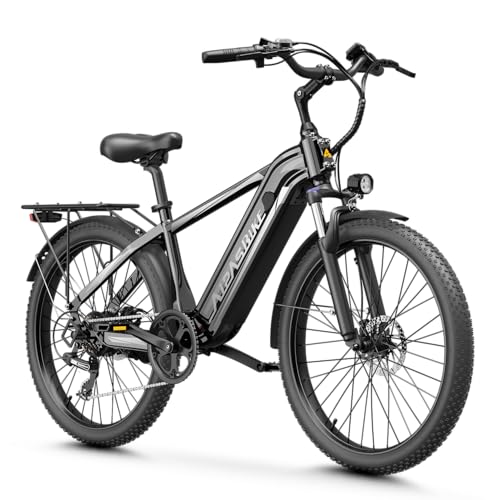
Pros
- Substantial 500-pound total load capacity supports heavier riders and utility cargo
- Large 864Wh battery capacity provides an extended range potential up to 85 miles
- Robust 1100W peak motor with 90Nm torque handles steep inclines up to 25 degrees
- Integrated rear turn signals and electric horn enhance urban commuting visibility
- Accommodates a wide rider-height range from 5'2" to 6'7" using adjustable handlebars
Cons
- Heavy 75-pound total bike weight makes lifting and transport difficult without help
- Speed capability up to 28 mph requires checking local municipal and trail e-bike rules
- Fixed non-folding 69-inch frame requires dedicated garage or ground-level storage space
The Aipas C2 Max is a heavy-duty electric utility and commuter bike designed for adult riders seeking substantial hauling power and long-distance travel capability. With a manufacturer-rated 500-pound total load capacity and an adjustable geometry that accommodates riders between 5'2" and 6'7", this model caters directly to larger cyclists, daily urban commuters, and riders who routinely transport heavy work gear or cargo.
Propulsion is powered by a rear hub motor providing 1100W of peak power and 90Nm of torque, designed to reach assisted speeds up to 28 mph and conquer hill grades up to 25 degrees. Energy is stored in a removable 48V 18Ah (864Wh) battery pack managed by an onboard battery management system. Manufacturer specifications estimate between 40 and 60 miles of real-world riding range, with up to 85 miles achievable under conservative pedal-assist usage, though exact range varies based on terrain, rider weight, and assist settings.
Chassis stability relies on 24 x 2.6-inch all-terrain tires that balance pavement efficiency with traction over gravel and light trails. Stopping performance is handled by dual disc brakes, supported by an adjustable front suspension fork that dampens road vibration and surface bumps. Urban safety is a central focus, as the bike comes factory-equipped with a bright headlight, an electric horn, and integrated rear turn signals to improve communication with surrounding automotive traffic.
Cockpit adjustments are straightforward thanks to adjustable handlebars and a clear LCD display that tracks speed, battery life, mileage, and the active assist mode. Riders can toggle between 5 levels of pedal assist while utilizing a 7-speed gear system to maintain an efficient pedaling cadence. Recharging the lockable battery requires approximately 4 to 6 hours, and its IP65 water resistance rating helps protect internal electrical components against dust and rain splashes.
Prospective buyers must consider the practical handling demands of a 75-pound e-bike measuring 69 inches in total length. Moving the bike up staircases, onto bus racks, or into apartment elevators can be cumbersome, making ground-floor storage or garage parking preferable. Additionally, because the motor allows speeds up to 28 mph, riders must verify local municipal guidelines, trail access regulations, and regional e-bike classifications before riding on municipal multi-use paths.
Based on product specifications, the Aipas C2 Max represents a strong option for riders prioritizing heavy load ratings, dependable hill-climbing torque, and substantial battery capacity. Its combination of an 864Wh energy reserve, 500-pound payload limit, and street-ready signaling equipment makes it a practical solution for demanding commutes and utility errands.
The Aipas C2 Max is powered by an 864Wh removable lithium battery operating at 48V and 18Ah. According to manufacturer specifications, this pack yields an estimated 40 to 60 miles of real-world range and up to 85 miles when riding in low-level pedal assist modes.
The battery housing features a key lock for frame security, an advanced battery management system (BMS) for electrical protection, and an IP65 water resistance rating against outdoor moisture. Charging from empty requires 4 to 6 hours using a standard electrical outlet. Because the battery is removable, riders have the convenience of charging the pack either directly on the bicycle frame or indoors at an office desk or apartment.
Electric propulsion is delivered by a motor producing 1100W of peak power and 90Nm of torque. This configuration supports assisted speeds up to 28 mph and allows riders to climb inclines up to 25 degrees under motor power.
Riders can regulate performance across 5 electronic pedal-assist levels paired with a standard 7-speed mechanical drivetrain. The LCD screen displays current speed and assist level in real time. Because the bicycle reaches speeds up to 28 mph, riders should verify local bike-path regulations and municipal trail access rules, as legal use limits vary across different jurisdictions and public pathways.
Engineered for high-capacity utility, the Aipas C2 Max supports a maximum total payload limit of up to 500 pounds. The bike's frame geometry and component adjustability are tailored to comfortably fit adult riders ranging from 5'2" to 6'7" in height.
Comfort and fit can be fine-tuned using the adjustable handlebar stem and adjustable front suspension fork. Wide 24 x 2.6-inch tires provide a balanced contact patch to distribute weight securely across asphalt, gravel, and packed dirt paths. Owners should plan for a total net bike weight of 75 pounds and overall physical dimensions of 69 by 27 by 42 inches when organizing storage and transport.

Pros
- Massive 500 lb total load capacity accommodates heavier riders, gear, and cargo errands
- Substantial 864Wh battery capacity provides an extended manufacturer-listed range of up to 85 miles in PAS mode
- Wide rider accommodation fitting heights from 5'1" to 6'5" using adjustable handlebars and an open step-through frame
- Integrated safety equipment includes front lighting, rear turn signals, and a loud horn for street riding
- Sturdy 24 x 2.6-inch tires and front suspension smooth out rough city streets and gravel paths
Cons
- At 74 pounds, the overall bike weight makes carrying it up stairs or onto vehicle racks demanding
- The 28 mph listed top speed requires riders to confirm local trail, greenway, and municipal e-bike path regulations
- 24-inch tire diameter is less common than standard 26-inch sizes for rapid local bike shop tube replacements
The Aipas C1 Max is a versatile, heavy-duty step-through electric city bike designed to meet the practical demands of daily urban commuters, campus riders, and utility cyclists. With an accessible low-step frame and a high load rating, it serves riders who require substantial carrying capability alongside dependable motorized assistance. Whether navigating stop-and-go downtown streets or hauling heavy loads across town, this model provides a stable, confidence-inspiring ride for everyday transportation.
Propulsion is delivered by a rear motor capable of reaching 1100W peak output and 90 Nm of torque, allowing it to tackle inclines up to 20 degrees while reaching a listed top speed of 28 mph. Powering the system is a lockable 48V 18Ah removable lithium battery providing 864 watt-hours of capacity, which recharges in approximately 4 to 6 hours. The manufacturer lists an estimated riding range of 40 to 60 miles under mixed conditions, extending up to 85 miles when using lower pedal-assist levels. Actual real-world range will naturally vary based on rider and cargo weight, terrain grade, wind resistance, ambient temperature, tire inflation, and assist settings.
Structural integrity is centered around a reinforced frame and front fork engineered to handle an exceptional total payload of up to 500 pounds. Road contact is managed by 24-inch by 2.6-inch fat tires paired with an adjustable front suspension fork that absorbs street ruts and rough pavement. Stopping duties are handled by dual disc brakes designed for responsive, controlled deceleration. The bike also features a 7-speed drivetrain, five levels of pedal assist monitored through an intuitive LCD display, and a safety suite that includes a bright headlight, rear turn signals, and an audible electric horn.
Ownership and daily usability are simplified by the bike arriving approximately 90 percent pre-assembled with the necessary tools and user manual included. The lockable, removable battery carries an IP65 water-resistance rating, enabling convenient off-bike charging at home or at a work desk. Rider fit is flexible, accommodating individuals from 5'1" to 6'5" through a combination of an open step-through design, an adjustable saddle, and angle-adjustable handlebars. Routine maintenance largely involves regular checks on tire pressure, brake cable tension, chain lubrication, and monitoring battery charging procedures.
Potential buyers should note a few trade-offs inherent to its heavy-duty build. At a net weight of 74 pounds, lifting the bicycle into high vehicle racks or carrying it up flights of apartment stairs requires noticeable physical effort. Additionally, while its listed 28 mph speed offers rapid transit, electric bicycle access rules and path classifications vary across municipal, state, and park jurisdictions, requiring riders to confirm local riding policies. Finally, the 24-inch tire diameter, while offering a lower center of gravity and stable handling, may be less widely stocked at standard neighborhood bike shops than conventional 26-inch or 27.5-inch sizes.
For commuters, larger riders, and errand runners who prioritize heavy payload support, hill-climbing torque, and substantial battery capacity at an accessible price point, the Aipas C1 Max represents a well-equipped option. Its combination of an 864Wh battery, broad rider sizing, and integrated safety lights makes it a practical, workhorse-style commuter for those who do not require an ultra-lightweight frame.
The Aipas C1 Max features a rear motor engineered to output up to 1100W peak power and 90 Nm of torque, enabling riders to climb hills with grades up to 20 degrees. It supports five levels of pedal assist along with a 7-speed transmission, allowing riders to dial in the appropriate motor assist for flat city roads or demanding inclines.
With a manufacturer-listed top speed of 28 mph, this e-bike provides brisk commuting performance. Because e-bike speed thresholds and path access rules vary significantly between states, cities, and recreational trail networks, riders should check local regulations regarding where 28 mph-capable electric bikes may be operated.
Equipped with a 48V 18Ah battery pack providing 864 watt-hours of capacity, the Aipas C1 Max provides substantial energy reserves for daily commuting and longer recreational trips. The battery pack is fully removable, lockable with a physical key, and rated IP65 for water resistance against splashes and light rain during everyday transit.
The manufacturer lists an estimated riding range between 40 and 60 miles under normal use, reaching up to 85 miles when utilizing lower pedal-assist levels. Riders should keep in mind that actual mileage per charge depends on variables such as rider weight, payload cargo, road grade, tire inflation pressure, ambient temperature, and throttle usage. Recharging the battery from empty takes approximately 4 to 6 hours using the standard charger.
Built with an open step-through geometry, the Aipas C1 Max allows for easy mounting and dismounting without swinging a leg over a high top tube. The cockpit features angle-adjustable handlebars and an adjustable seat post, accommodating riders between 5'1" and 6'5" in height for an upright, relaxed riding posture.
The reinforced frame and front fork are rated to support up to 500 pounds of total load capacity, making it a viable platform for carrying heavier cargo or gear. However, the bike itself weighs 74 pounds, so riders should account for this net mass when planning to lift the bike into an SUV, carry it up apartment stairs, or mount it to a vehicle hitch rack.

Pros
- 560W motor provides brisk acceleration up to a listed top speed of 20 mph
- Removable 48V 10Ah battery allows easy off-bike charging at any standard wall outlet
- Dual mechanical disc brakes offer reliable stopping response in everyday riding conditions
- Foldable frame footprint saves substantial floor space in apartments, dorms, and vehicle trunks
Cons
- Listed total weight of 60 pounds requires noticeable physical effort when carrying the folded frame up stairs
- Manufacturer specifications do not provide a specific estimated range in miles per charge
- Compact 14-inch wheels roll less smoothly over deep potholes and rough asphalt compared to full-sized bike tires
The LELEKUAI 14-Inch Folding Electric Bike is a compact runabout developed for teenagers, adult commuters, and apartment dwellers who prioritize a small storage footprint. Designed specifically for paved roads, city routes, and local trips, it offers an approachable alternative to full-sized bicycles without requiring dedicated garage space.
Propulsion is handled by a 560W motor that delivers a manufacturer-listed top speed of up to 20 mph. Riders have access to versatile control options, including full electric throttle propulsion, motor-assisted pedaling, or traditional manual cycling when you want a workout. Power is supplied by a 48V 10Ah lithium battery pack designed to handle everyday commuting needs. Keep in mind that exact distance per charge will always fluctuate according to rider weight, throttle frequency, pedaling effort, wind, and street gradients.
The structural build centers around a sturdy folding frame paired with 14-inch wheels. These smaller wheels keep the overall bike length minimal, facilitating sharp, responsive turning around tight city corners. Stopping control is managed by front and rear dual disc brakes, which provide positive, predictable bite to manage downhill speeds and sudden pedestrian hazards.
Daily ownership and storage are made simpler by the quick-folding frame latch. You can collapse the bicycle to fit into car trunks, RV storage compartments, or behind an office desk. The removable battery pack adds notable convenience, as you can leave the 60-pound bicycle in a secure location while carrying just the battery inside for charging.
Riders should recognize the practical tradeoffs inherent in this design. At roughly 60 pounds, this is not a featherweight commuter, and repeatedly carrying it up multiple flights of stairs will demand considerable arm strength. In addition, 14-inch wheels offer less rollover capability than larger 20-inch or 26-inch bicycle tires, making it important to keep an eye out for road debris, cracks, and deep potholes.
Overall, the LELEKUAI folding e-bike serves as a straightforward, functional transit tool for budget-minded riders wanting a compact motorized ride. If you need a small-format commuter with a 20 mph top speed, dual disc brakes, and an easily removable battery for simple indoor charging, this model fits the bill nicely.
A high-torque 560W motor powers the rear wheel, allowing the LELEKUAI folding bike to achieve a listed top speed of up to 20 mph. This provides sufficient pace to keep up with urban traffic lanes and dedicated city bikeways.
The control setup gives riders the flexibility to select between full electric motor cruising, assisted pedaling to reduce physical exertion, and unassisted manual pedaling. Because local municipal and state regulations differ regarding electric bicycle operation, speed caps, and throttle permissions, riders should review their local traffic laws before using public pathways.
Energy is stored in a 48V 10Ah lithium battery integrated into the frame. A key benefit of this configuration is its modular design, which allows the battery pack to be unlocked and removed in seconds.
Detaching the pack lets you charge the unit indoors at standard household wall outlets, eliminating the hassle of dragging a 60-pound bicycle into living rooms or offices. Always utilize the supplied charging equipment and follow recommended manufacturer storage temperatures to preserve battery longevity.
The LELEKUAI is engineered with a central frame hinge that quickly folds the bike into a condensed shape. This design significantly eases transportation inside automobile trunks, camper storage lockers, and compact urban apartments.
While the folding mechanism drastically reduces the bicycle footprint, prospective buyers should factor in the listed weight of 60 pounds. Lifting the bike into high SUV cargo spaces or carrying it onto public transit requires moderate physical exertion compared to non-motorized folding alternatives.

Pros
- Quick-folding mechanism makes tight apartment storage and trunk transport straightforward.
- Removable lithium battery allows indoor charging without hauling the entire bike inside.
- Dual disc brakes deliver dependable stopping control on paved roads.
- 560W motor provides brisk assistance for urban commuting and errand running.
Cons
- At 48 pounds, lifting and carrying the bike up multiple flights of stairs requires noticeable physical effort.
- Compact 14-inch wheels feel pavement cracks, bumps, and potholes more distinctly than full-size bike wheels.
- Product documentation contains conflicting battery voltage references, listing both 36V and 48V configurations.
The LELEKUAI 14-inch folding electric bike is engineered as a compact personal mobility solution tailored for urban commuters, students, and apartment dwellers. With smaller wheels and a collapsible frame, it targets riders who need a practical way to bypass traffic congestion or cover last-mile transit gaps without taking up the footprint of a full-size bicycle. Its hybrid setup combining pedal assist, motorized cruising, and standard pedaling makes it suitable for quick trips across campus, daily transit connections, and neighborhood errands.
Propulsion comes from a 560W motor capable of accelerating to manufacturer-listed top speeds between 21.6 and 24 mph depending on the selected operating mode and riding conditions. Riders can tailor their effort using three levels of pedal assist, switch into full electric mode, or rely entirely on leg power through the integrated pedals. Power is supplied by a removable 10Ah lithium battery, though buyers should note manufacturer materials reference both 36V and 48V specifications. As with any e-bike, practical mileage on a single charge fluctuates based on rider weight, road grade, assist level selection, and stop-and-go city riding.
The chassis relies on a compact rigid structure rolling on 14-inch wheels that prioritize nimble maneuvering in tight spaces over high-speed touring stability. Stopping duties are handled by front and rear mechanical disc brakes, offering dependable bite and consistent braking leverage when navigating unpredictable urban intersections. The compact wheel diameter keeps the bike agile around obstacles, though riders will want to remain mindful of uneven pavement, road cracks, and potholes that larger bike tires roll over more easily.
Daily ownership benefits from the quick-folding frame design that allows the bike to collapse down for storage in compact car trunks, under office desks, or inside modest apartment closets. Detaching the battery simplifies charging routines, letting you bring the power pack indoors to an ordinary wall outlet while leaving the frame parked in a garage or storage area. At 48 pounds, lifting the folded unit into a vehicle cargo area is manageable for most adults, though carrying it up multiple flights of stairs on a regular basis requires deliberate physical effort.
While the compact footprint provides immense storage convenience, potential owners should weigh the trade-offs of small-diameter wheels and modest frame dimensions. Taller riders may find the cockpit geometry compact during extended riding sessions, and the lack of full suspension means uneven pavement transmits directly through the frame. Additionally, the discrepancy in listed battery voltage within the product documentation means real-world electrical output should be approached with realistic expectations.
For city dwellers and suburban travelers seeking an accessible, trunk-friendly folding commuter for short-distance utility and errand running, the LELEKUAI offers a versatile balance of motorized assistance and space-saving portability. It functions best on smooth city pavement and dedicated bike paths where agile handling, reliable disc braking, and easy indoor battery charging matter most.
The LELEKUAI electric bike features a 560W motor designed to deliver brisk acceleration for flat city street riding and everyday urban travel. The motor supports cruising speeds listed up to 24 mph, giving riders ample pace to keep rhythm with city bicycle traffic. Operational speeds may vary depending on payload, terrain incline, and rider input.
Riders can toggle through three levels of pedal assist to balance personal effort with battery conservation. In addition to pedal assistance, the bike supports a full electric mode for motorized riding, as well as a conventional pedal-only mode that allows standard cycling when the motor is turned off or the battery runs low.
Designed specifically for tight living spaces and multi-modal transit, this e-bike incorporates a quick-folding frame mechanism that collapses the bike into a compact bundle. This layout makes it practical to stow in small car trunks, recreational vehicles, or closet corners where a traditional full-sized bike frame would not fit.
Weighing in at 48 pounds, the bike retains enough heft to feel sturdy during street riding while remaining portable enough for loading into vehicle cargo bays. The inclusion of a removable lithium battery also helps lighten the frame slightly when lifting, and allows riders to recharge the battery indoors without moving the complete bike.
Stopping power is provided by a dual disc brake system featuring calipers and rotors on both the front and rear 14-inch wheels. Dual disc setups provide responsive braking performance and direct lever feedback, which proves vital when riding near heavy pedestrian foot traffic, driveways, and street intersections.
Because local regulations regarding motorized bicycles, assisted speeds, and bike path access vary significantly across U.S. states and municipalities, prospective riders should check municipal guidelines regarding e-bike riding rules, helmet requirements, and sidewalk restrictions in their specific area.

Pros
- UL2849 safety certification for the complete electrical system provides reliable peace of mind.
- Relatively lightweight 45-pound build makes handling easier than many bulkier folding models.
- Wider 20 x 2.6-inch tires offer improved traction and stability over standard thin commuter tires.
- Dual charging options allow the 48V battery to be charged directly on the bike or removed for indoor charging in about 5.5 hours.
- Folded dimensions of 37.4 x 17.7 x 27.5 inches allow it to fit inside most vehicle trunks.
Cons
- The 7.8Ah battery capacity yields a limited throttle-only range listed at roughly 15.5 miles.
- Requires turning the physical key clockwise to the end to activate battery power before riding, which can confuse first-time users.
- Rigid frame setup lacks dedicated front or rear suspension components for rough off-road terrain.
The Gotrax R1 is a compact, folding commuter e-bike designed primarily for urban riders, students, RV travelers, and apartment residents who require assisted transportation without the storage footprint of a full-size bicycle. Folding down to 37.4 x 17.7 x 27.5 inches and weighing approximately 45 pounds, it targets riders who need to keep their bike inside a hallway closet or load it into a car trunk for multi-modal travel.
Propulsion is handled by a rear motor rated at 350 watts with a 500-watt peak output, allowing riders to reach assisted speeds up to 20 mph. The 48V 7.8Ah battery supports three operating modes: pure electric throttle, pedal assist, and standard manual pedaling. Gotrax specifies up to 15.5 miles on pure throttle, 25 miles under typical pedal assist, and up to 40 miles when riding in pedal-assist level 1. Recharging the battery takes roughly 5.5 hours and can be done while mounted on the frame or taken indoors for convenience.
Built around a 20-inch wheel platform, the Gotrax R1 features 20 x 2.6-inch tires that provide a wider contact patch than standard narrow city tires, helping dampen road vibration over cracks and light gravel. Stopping control comes from dual mechanical disc brakes on the front and rear wheels. Rider awareness and night visibility are addressed through a factory-installed LED headlight, rear reflector, handle-mounted bell, and an LCD smart display that tracks speed, mileage, and assist settings.
Living with the Gotrax R1 is straightforward, though riders must remember that battery activation requires turning the physical key clockwise to the final position before powering up the display. At 45 pounds, lifting the bike into an SUV or trunk is manageable for many adults, though carrying it up multiple flights of stairs still requires decent physical effort. Routine ownership tasks include maintaining proper tire pressure, inspecting brake cable tension, and checking the folding latch mechanisms before each ride.
Potential buyers should consider realistic performance limitations before purchasing. A 7.8Ah battery capacity means heavy throttle usage or hilly terrain will deplete battery reserves relatively quickly compared to larger-capacity touring bikes. Additionally, the lack of front or rear suspension means that road comfort relies largely on the 2.6-inch tires and proper tire inflation.
The Gotrax R1 represents a sensible choice for campus riders, city commuters, and travelers seeking an affordable, folding 20 mph electric bike. Its UL2849 electrical certification, dual disc brakes, and moderate carry weight make it a dependable option for urban mobility where compact storage is essential.
The Gotrax R1 is powered by a 48V 7.8Ah battery pack that provides an energy baseline suited for short-to-medium urban commutes. Manufacturer specifications state a pure electric range of up to 15.5 miles and pedal-assist range up to 25 miles under mixed conditions, reaching up to 40 miles in assist level 1.
Charging the battery takes approximately 5.5 hours from empty. The design supports dual charging methods, meaning you can plug the charger directly into the bike frame or unlock and slide the battery out to charge it indoors at your desk or home. Before powering up the LCD display, riders must insert the key into the battery lock cylinder and rotate it fully clockwise to complete the electrical circuit.
Compact storage is the defining mechanical attribute of the Gotrax R1. When fully folded, the bike measures 37.4 x 17.7 x 27.5 inches, compared to its unfolded riding dimensions of 65.3 x 26.7 x 48.4 inches.
At an official weight of 45 pounds, the R1 is lighter than many fat-tire folding e-bikes on the market. This reduced weight profile simplifies lifting the folded frame into vehicle trunks, camper storage bays, or office corners. Users should regularly verify that the central frame hinge and handlebar stem latches are firmly locked before every trip.
The Gotrax R1 features electrical certification under UL2849, verifying that its electrical drive system, battery, and controller meet standard consumer safety benchmarks. Dual disc brakes provide positive mechanical stopping power across both wheels for reliable deceleration in urban traffic.
For riding in low-light environments, the R1 comes equipped with an integrated forward LED headlight, a rear passive reflector, and a handlebar bell to signal pedestrians. The bright LCD display ensures speed, assist modes, and battery status remain legible during day and night rides.
Frequently Asked Questions
What payload capacity should you expect from a heavy duty electric bike with pedals?
Heavy-duty utility models typically support payloads up to 500 lbs, whereas compact folding models generally hold between 220 and 265 lbs. For example, Aipas models feature reinforced frames and forks rated for 500 lbs to safely carry heavier loads. Compact folding options prioritize portability with lower payload thresholds. Always verify that the manufacturer rating covers both rider weight and added cargo.
How does motor torque affect hill climbing under heavy loads?
Motor torque, measured in Newton-meters (Nm), determines climbing capability under heavy loads far more directly than top speed. A motor with 90Nm of torque delivers the low-speed force required to scale steep inclines. Lower-power motors handle gentle slopes but require extra rider pedaling on hills. Balancing nominal wattage with peak torque keeps the motor running cool.
What causes real-world battery range to fall short of advertised estimates?
Real-world mileage often falls 20 to 40 percent below maximum advertised numbers because riding conditions heavily impact energy consumption. An 864Wh battery may claim 85 miles of assist, but carrying heavy loads or using full throttle drops realistic distance to 40-60 miles. Stop-and-go city traffic, colder temperatures, and lower tire pressures also accelerate battery drain.
Are mechanical or dual disc brakes sufficient for heavy cargo bikes?
Yes, dual disc brakes provide the necessary stopping force to halt heavier bikes safely across various pavement surfaces. Both full-size utility models and compact commuters rely on dual disc brakes to distribute braking friction evenly. Carrying extra weight increases stopping distances, so keeping brake pads properly aligned and cables tensioned is vital for safety.
How can riders improve overall comfort on stiff utility frames?
Upgrading key touchpoints like your saddle and adjusting front suspension forks significantly smooths out road chatter. Sturdy utility frames utilize rigid tubing to bear weight, which can transmit pavement bumps directly to the rider. Adding an ergonomic electric bike seat cover reduces fatigue, while pairing practical gearing with pedaling keeps your ride efficient, unlike complex affordable electric bike high wattage designs.


Write Your Review
No reviews yet. Be the first to share your experience!