


A paved trail can look open to every kind of small electric vehicle, but access rules often distinguish bicycles from scooters. If you’re asking are electric scooters allowed on bike trails, the practical answer is: sometimes, and the trail manager’s rules matter more than the surface or the presence of a bike symbol. State and local regulations, land manager policies, and posted signs can all affect access.
That distinction is especially useful when considering a seated model such as the GREATWORK Peak 1500W Electric Scooter with Seat. Its product description lists a 1000W motor with 1500W peak power and a stated top speed of 25 mph, but those specifications do not establish that it is legally classified as an e-bike or permitted on a particular trail. For background on other electric two-wheelers, see our Vivi electric bike guide and electric bikes for trail use.
Pros
- Strong 1000W motor with 1500W peak power provides quick acceleration and capable 30-degree hill climbing
- Removable 48V 10Ah (480Wh) battery allows convenient indoor charging without hauling the entire vehicle
- Wide 16x3.0-inch fat tires and dual front fork suspension deliver improved stability over small bumps and cracks
- Practical integrated cargo basket on the lower deck simplifies running errands and transporting everyday items
- Front and rear disc brakes offer dependable mechanical stopping control in city riding environments
Cons
- At 59.5 pounds, the substantial frame weight makes frequent carrying up stairs or lifting into vehicle trunks demanding
- The 30-mile maximum range is calculated under ideal test conditions and will decrease with heavier loads, hills, or high-speed riding
- Seated scooter configuration lacks pedals, meaning propulsion relies entirely on battery power with no human-powered backup
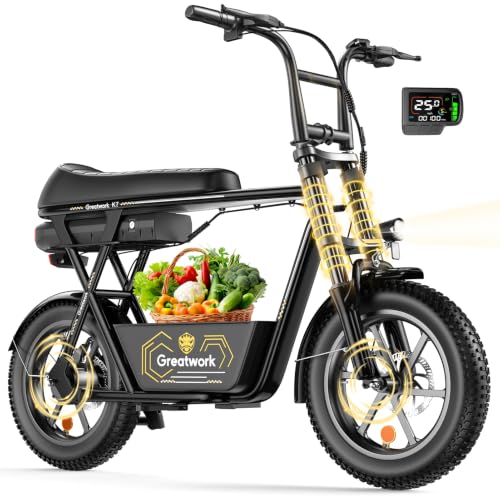
The GREATWORK K7 is a seated electric scooter engineered for riders who prioritize comfortable, seated urban transit over traditional standing scooters or pedal-operated bicycles. Designed with a motorcycle-inspired profile and a 59.5-pound frame, this electric rideable caters directly to suburban commuters, college students, campus travelers, and neighborhood errand-runners who want effortless throttle-driven mobility without breaking their budget.
Propulsion centers on a 1000W rated motor capable of delivering up to 1500W peak power, pushing the vehicle to a manufacturer-listed top speed of 25 mph. The powertrain offers multiple speed modes and handles slopes up to 30 degrees, making short climbs and city overpasses manageable. Supplying power is a 48V 10Ah (480Wh) lithium battery pack positioned beneath the saddle rather than inside the low deck. While the manufacturer lists a maximum range of up to 30 miles under ideal conditions, actual real-world mileage naturally fluctuates depending on rider weight, terrain grade, throttle frequency, and outdoor temperatures.
Ride quality relies on 16x3.0-inch fat tires paired with a dual front suspension fork, providing substantially more stability and bump absorption than small-wheeled micro-mobility scooters. Stopping duties are handled by front and rear disc brakes designed to maintain responsive stopping control during daily street navigation. A high-definition LCD screen mounted on the handlebar keeps vital statistics in clear view, including current speed, active gear mode, remaining battery charge, and odometer mileage.
Utility is a prominent highlight, featuring a deep cargo basket mounted directly to the lower deck platform, making it practical for carrying grocery sacks, work totes, or small packages. Rider comfort is reinforced by an extended, padded bench seat that supports relaxed positioning on longer neighborhood routes. Because the 480Wh battery is completely removable, riders living in apartments or working in offices can simply unlock the pack and charge it indoors using standard wall outlets without dragging the 59.5-pound scooter inside.
Prospective buyers must weigh a few key trade-offs before purchasing. At nearly 60 pounds, the GREATWORK K7 is not ultra-portable and can be cumbersome to haul up multi-flight staircases or fit into compact car trunks. Furthermore, because this is a throttle-only seated scooter without a pedal drivetrain, you cannot pedal home if the battery runs out, making vigilant battery level monitoring essential for longer excursions.
For urban commuters, campus riders, and suburban errand-runners seeking an affordable seated electric vehicle with solid power output and integrated cargo hauling, the GREATWORK K7 delivers substantial everyday utility. Its combination of a peak 1500W motor, removable 480Wh battery, plush wide tires, and front suspension offers a reliable and comfortable alternative to standing e-scooters for short-to-medium distance daily transit.
The GREATWORK K7 features a 1000W electric motor delivering up to 1500W of peak power output. This setup provides strong acceleration and an official top speed rating of 25 mph, supported by multiple gear levels (ranging from 9.6 mph up to 20+ mph) to match varied riding environments. The motor provides climbing capability on inclines rated up to 30 degrees, assisting riders across rolling streets and modest city hills.
Equipped with a 48V 10Ah (480Wh) battery, the K7 lists an estimated maximum range of up to 30 miles per charge under ideal riding conditions. The battery pack is located beneath the seat rather than under the foot platform, which helps protect it against puddle splashes and road debris. Conveniently, the battery is fully removable, allowing riders to recharge indoors at home or at a work desk without bringing the entire vehicle inside.
Equipped with 16x3.0-inch pneumatic fat tires, this seated scooter offers a wider contact patch and better vibration damping than traditional compact scooter wheels. Up front, a dual suspension fork actively smooths out pavement seams, cracks, and modest bumps. For stopping, the scooter relies on mechanical disc brakes on both the front and rear wheels, providing predictable braking power during urban transit.
The vehicle includes an enlarged, deep utility basket positioned on the lower deck between the rider's legs, creating functional storage for grocery bags, gym gear, or small parcels. Coupled with an elongated, thickly cushioned seat and full 90 percent factory pre-assembly, the K7 is built for functional neighborhood errands straight out of the shipping carton.
How Trail Access Rules Apply to Electric Scooters
There is no single nationwide answer for every bike trail. Electric scooter access can depend on the state or locality, who manages the trail, how the facility defines permitted vehicles, and whether signs set additional restrictions. A route that allows bicycles or certain classes of e-bikes may not automatically allow a motorized scooter. Check the rules for the exact trail before riding rather than relying on the trail’s name or appearance.
Why a bike trail label does not settle the question
“Bike trail” is a convenient description, not a guarantee that every vehicle with two wheels is allowed. Trail managers may distinguish conventional bicycles, electric bicycles, electric scooters, mobility devices, and other motorized vehicles in their policies. Some paths may permit certain powered vehicles while others restrict motorized use, even if both routes are paved and open to the public.
Access rules may also differ between sections of one connected route. A municipal segment, a state-managed trail, and a path crossing private or federal land can have different rules or signs. At an entry point, look for posted vehicle restrictions and any definitions of scooter, motor vehicle, or electric bicycle. If the wording is unclear, contact the land manager before setting out.
Do not assume that a product’s marketing category answers a legal question. A scooter with a seat remains a scooter in its product description, and a seat alone does not make it an electric bicycle. Likewise, an advertised speed or motor rating does not by itself establish an e-bike class or trail eligibility. The relevant local definitions and the trail operator’s rules need to be checked separately.
Check the specific route and the authority that manages it
Start with the official trail or park website, because it may publish permitted-use rules, maps, temporary closures, and contact details. Search for the route name together with terms such as electric scooter access, motorized vehicles, or trail rules. A general page about bicycles may not explain how the manager treats scooters, so look for language that specifically covers motorized devices.
Next, identify who is responsible for the segment you plan to use. A city parks department, county, state agency, regional authority, or private operator may set the rules. If a route crosses management boundaries, confirm access for each relevant segment instead of treating the entire route as one facility. Posted signs at the entrance and along the route remain important, especially if rules have changed temporarily.
When the policy does not explicitly mention scooters, ask the trail manager whether the particular type of seated electric scooter is allowed. Give the product category and its relevant specifications if requested, but avoid presenting its speed or motor rating as proof of a legal classification. A clear answer from the responsible authority is more useful than assumptions drawn from a retailer listing, a map icon, or another rider’s account.
For broader context on the difference between electric bicycle products and trail-oriented models, our commuter e-bike overview and trail-focused electric bike guide cover a separate product category. Those guides cannot determine a scooter’s permission on a given trail, but understanding the category distinction can help you ask the trail manager a precise question.
What the GREATWORK scooter specifications do and do not tell you
The GREATWORK Peak 1500W Electric Scooter with Seat is described as having a 1000W motor, 1500W peak power, a 48V 10Ah removable battery rated at 480Wh, and a manufacturer-stated top speed of 25 mph. Its description also lists five speed levels, fat tires, dual suspension, front and rear disc brakes, and a removable battery. These are product details to consider when evaluating intended use, but they do not answer whether a trail permits the scooter.
In particular, the listed top speed should not be treated as proof of a legal class. E-bike classifications and access policies are defined by applicable rules, not inferred from a product title, seat, motor wattage, or advertised speed alone. A motor rating may be relevant if a rule asks for it, but the operator must interpret the regulation and the vehicle category. Do not relabel the product as an e-bike simply because it is used on a path.
The product description states a range of up to 30 miles under ideal conditions. That is a manufacturer claim, not a guaranteed distance for every ride, and it does not expand legal access. Terrain, rider and cargo load, speed, battery condition, and other conditions can affect actual distance. For trail planning, confirm the route length and whether charging or another option is available, while treating the listed range as conditional.
The description also mentions a seat that can accommodate two people and a basket intended for cargo or pets. Those statements do not establish that passenger riding, carrying an animal, or using the basket is permitted or appropriate on a particular shared trail. Check trail rules and product instructions, and consider how a larger seated scooter and carried items may affect maneuvering in crowded or narrow spaces. Do not assume that an accessory or seating feature changes the vehicle’s legal category.
Access is only one part of deciding whether a trail is suitable
Permission to enter does not mean every route is a good match for every scooter. Trail width, surface, crowding, intersections, grades, and the presence of pedestrians can shape whether a vehicle is manageable there. The GREATWORK description identifies 16-by-3.0-inch tires and dual suspension, but those details do not prove suitability for every surface or trail condition. Follow signs, operate within the manufacturer’s guidance, and use protective equipment appropriate to the ride.
Shared paths call for awareness of other users and compliance with any posted speed or passing rules. Do not treat the scooter’s stated top speed as a target for a crowded trail. Ride only at a speed and in conditions that allow you to remain in control, and yield as the local rules require. If a route is busy, narrow, or unfamiliar, choosing another permitted route may be the more practical decision.
Brakes and controls matter to the suitability decision, but product claims should be read carefully. The GREATWORK description lists dual disc brakes and an LCD display; it does not provide independent stopping-distance data or a trail-safety certification. Inspect and maintain the scooter according to its manual, and do not rely on a feature list as a substitute for safe operation. If a control or brake appears faulty, do not ride until the issue has been addressed appropriately.
Battery planning is another practical consideration, separate from trail permission. The removable battery may allow charging away from the scooter, according to the product description, while the stated capacity is 480Wh. Use the manufacturer’s charging instructions and the supplied or explicitly approved charging equipment; connector appearance or nominal voltage alone does not prove charger compatibility. Keep the battery and charger within the conditions specified by their instructions.
Common assumptions that can lead to a wrong answer
A common mistake is assuming that any path marked for bicycles allows electric scooters. That conclusion skips the distinction between bicycles, e-bikes, and scooters, and ignores local policies. Another mistake is treating a scooter’s maximum speed as its legal classification. Neither a bicycle symbol nor a single specification is a substitute for checking the actual rule.
Online maps and informal rider reports can be useful for locating a route, but they may be incomplete, outdated, or about a different segment. A report that someone rode there does not prove that the use is authorized. Trail rules may also change because of construction, seasonal management, special events, or updated policies. Verify current official information close to the date of your ride.
It is also easy to confuse a motorized access rule with an e-bike rule. A trail may allow a specified class of electric bicycle while prohibiting other motorized devices, or it may use definitions that require closer reading. Avoid assuming that a seated scooter falls into an allowed class because it has pedals, a display, or bicycle-style components; the supplied GREATWORK description does not list pedals or an e-bike class.
Finally, do not rely on a product’s advertised range to plan a route without allowing for real conditions. The listed 30-mile figure is explicitly tied to ideal conditions, and actual range can vary. A longer or hillier route, frequent stops, higher speeds, or other conditions may change energy use. Plan conservatively and make sure your route choice complies with the trail’s access rules before considering distance.
A practical decision before setting out
For a specific ride, confirm three things: the exact vehicle category, the current rules for every trail segment, and any posted restrictions at the access point. If the policy uses terms that do not clearly cover a seated electric scooter, ask the managing authority rather than guessing. Keep a record of the official guidance if the answer is not obvious, and check again when using a different trail system.
If scooters are allowed, follow the trail’s speed, yielding, and operating rules, and choose a route suited to the scooter and current conditions. If access is prohibited or remains uncertain, use a route where motorized scooters are explicitly permitted. That decision is more reliable than trying to infer permission from the GREATWORK scooter’s power, speed, tires, or seat.
The practical answer is conditional: an electric scooter may be allowed on some bike trails, but permission depends on the rules set by the relevant state, locality, trail operator, and facility. Verify the exact route and vehicle category before riding. Product specifications can inform your planning, but they cannot replace the trail manager’s access policy.


Write Your Review
No reviews yet. Be the first to share your experience!