


A bike’s battery voltage alone can’t tell you how fast it will travel. Motor output, controller settings, the bike’s design, and the way a rider uses pedal assist or a throttle all matter, so two bikes with 48V batteries can have different listed top speeds. How fast can a 48v electric bike go is a useful question, but a careful answer needs more than the voltage printed in a product description.
The products listed below illustrate that difference: some 48V models list a top speed of 20 mph, while others advertise higher figures. Those are manufacturer-provided specifications, not a promise of the speed every rider will reach in ordinary conditions. If you’re comparing everyday riding and trail-oriented options, our Kamingo e-bike guide and Vivi electric bike guide offer related brand-specific reading. This guide explains what a 48V rating does and does not tell you, how to interpret the listed speeds, and which details to check before buying.
Top Products

Pros
- Full UL 2849 bike certification and UL 2271 battery certification provide independent electrical safety validation
- Integrated 60-pound rear rack adds immediate utility for commuting, grocery trips, and work gear
- Wide 4.0-inch fat tires and front suspension fork provide stability across dirt paths, gravel, and rough city streets
- Removable 48V 13Ah battery allows convenient off-bike charging at home or at the office
Cons
- Total bike weight of 68.3 pounds makes lifting onto vehicle racks or carrying up stairs challenging
- Manufacturer-listed recharge time of approximately 6.5 hours requires planning ahead between long rides
- Assisted top speed is capped at 20 mph, which may feel modest for riders seeking higher-speed road commuting
The Funhang 26-inch electric mountain bike is a versatile fat-tire model designed for adult commuters, weekend recreational riders, and utility users needing dependable cargo capability. Combining wide all-terrain tires with practical commuting hardware, it suits riders between 5 feet 3 inches and 6 feet 2 inches who want stable handling on neighborhood streets, packed dirt paths, and light off-road trails. With a generous 330-pound total weight capacity and a built-in rear cargo rack, this build easily transitions from daily work runs to casual weekend exploring.
Propulsion is delivered by a 500-watt nominal motor capable of reaching 1000 watts at peak output, generating 66.6 Newton-meters of torque for dependable acceleration. The system supports a listed top assisted speed of 20 mph across five distinct operating modes: Pure Electric Mode, Assisted Bicycle Mode, Normal Bike Mode, Cruise Mode, and a Booster walking mode. Energy is supplied by a removable 48V 13Ah lithium-ion battery featuring an IPX5 water resistance rating and integrated battery management system (BMS) protection. The manufacturer lists a range of 30 to 35 miles on pure electric power and 55 to 60 miles in pedal assist mode, though actual distance will vary based on rider weight, terrain gradient, wind, tire inflation, and assist level.
The physical build centers around 26 x 4.0-inch anti-skid fat tires mounted beneath a front suspension fork, creating a forgiving contact patch that dampens vibrations over potholes, gravel, and uneven surfaces. Braking is handled by dual 180mm mechanical disc brakes that provide reliable stopping leverage even when carrying cargo. A standard 7-speed gearing system allows riders to maintain an efficient pedaling cadence up hills, while a handlebar-mounted LCD display shows real-time metrics including speed, assist level, trip mileage, and remaining battery life.
Arriving approximately 85 percent pre-assembled, final assembly involves installing the front wheel, handlebars, pedals, and lighting hardware using the provided manual and installation guidance. Daily charging logistics are straightforward, as the battery can be charged directly on the frame or unlocked and removed for indoor charging in roughly 6.5 hours. To improve safety in low-light conditions, the bike comes equipped with a front headlight alongside a rear taillight that integrates turn signal functionality.
Prospective owners should take into account the bike's physical size and mass during storage and transport. At 68.3 pounds, hoisting this e-bike onto standard vehicle racks or carrying it up multi-flight apartment staircases requires notable effort. In addition, the assisted speed tops out at 20 mph, which aligns with standard Class 2 parameters but will not satisfy riders looking for higher-speed Class 3 performance on open roadways. Furthermore, the IPX5 rating applies specifically to the battery pack, meaning proper care should still be taken to avoid submerging components or riding through severe rainstorms.
For everyday commuters, budget-conscious riders, and outdoor enthusiasts seeking an affordable, certified electric bicycle, the Funhang fat tire e-bike offers a solid set of functional features. Backed by recognized UL 2849 system-level and UL 2271 battery certifications, a sturdy 60-pound rear rack, and versatile all-terrain rubber, it represents a capable utility option for riders prioritizing comfort, cargo utility, and safety compliance under 20 mph.
The Funhang e-bike features a 500-watt nominal hub motor capable of 1000 watts of peak power and 66.6 Newton-meters of torque, delivering steady assistance up to a listed top speed of 20 mph.
Riders can select from five pedal assist levels or cycle between five working modes, including Pure Electric throttle operation, standard pedal assist, human-powered cycling, a cruise control function, and a low-speed booster mode designed to assist when pushing the bike on steep inclines.
The bike is powered by a removable 48V 13Ah lithium-ion battery pack with an IPX5 water resistance rating and internal BMS protection. Under manufacturer testing conditions, it provides an estimated 30 to 35 miles of range using throttle only and 55 to 60 miles using pedal assist.
Recharging takes approximately 6.5 hours from empty. Because real-world mileage is heavily influenced by rider weight, cargo load, terrain gradient, and wind resistance, actual range will vary across different operating environments.
Designed with utility in mind, the Funhang e-bike supports a maximum overall payload of 330 pounds and fits riders between 5 feet 3 inches and 6 feet 2 inches in height.
A dedicated rear cargo rack comes pre-installed and is rated to carry up to 60 pounds, offering a solid mounting platform for commuter bags, panniers, or grocery crates for daily urban errands.
Electrical system safety is independently verified through recognized third-party test standards. The complete e-bike system complies with the UL 2849 standard as recognized by TUV, assessing electrical drive, controller, and system integration.
The 48V 13Ah lithium-ion battery pack complies with the UL 2271 standard recognized by SGS, ensuring certified battery cell assembly, electrical protection, and thermal management standards for everyday charging and storage.

Pros
- Generous 48V 13Ah removable battery capacity supports convenient indoor or office charging away from the bike.
- Small 16-inch wheels combined with 3-inch wide tires deliver responsive handling and extra cushioning on uneven pavement.
- Integrated front and rear lighting system enhances everyday rider visibility without the need for aftermarket lights.
- Mechanical disc brake design provides familiar, straightforward maintenance using standard bicycle cable adjustments.
Cons
- Manufacturer specifications do not state the nominal motor wattage, total bike weight, or maximum rider payload limit.
- Compact 16-inch wheel diameter can feel more sensitive to large potholes and steep curbs than full-size 26-inch or 27.5-inch wheels.
- Mechanical disc brakes require periodic manual cable adjustments to maintain optimal lever feel as cables stretch over time.
The URLIFE 16-inch fat tire electric bike is a compact city cruiser engineered for adults and teens who want an agile, space-saving ride for daily transportation. Built on a small silver frame, it addresses the needs of urban apartment dwellers, students, and casual commuters who find traditional full-sized electric bicycles too bulky to store or maneuver in tight quarters. By blending a smaller wheel diameter with wide 3.0-inch tires, this model focuses on practical neighborhood utility, errand running, and short-distance urban transit.
Propulsion comes from a brushless rear hub motor capable of reaching advertised speeds of up to 28 mph. Riders can cycle through three distinct speed levels and toggle between pure electric mode and pedal assist depending on whether they prefer motor-only cruising or extended pedaling support. Power is supplied by a 48V 13Ah removable lithium-ion battery, with URLIFE listing an estimated pedal-assist range of 40 to 60 miles per charge. Real-world mileage will naturally vary based on rider weight, terrain slope, headwind, tire pressure, and how heavily the throttle is utilized.
Hardware specifications center on accessibility and straightforward mechanical simplicity. The bicycle features 16x3.0-inch inflatable tires that provide a broader contact patch than standard skinny city tires, aiding stability across asphalt, light gravel, or packed dirt. Stopping duty is managed by front and rear mechanical disc brakes that provide reliable stopping leverage. To counter the rigid nature of a compact frame, URLIFE includes an ergonomic saddle supported by a dual-spring suspension system, which helps filter out sharp jolts from uneven sidewalks and minor road seams.
Ownership and everyday handling are made simpler by the removable battery design, allowing riders to leave the frame locked outside or stored in a garage while carrying only the power pack inside to recharge. The integrated high-brightness LED headlight and rear taillight run directly from the bike electrical system, removing the hassle of charging separate clip-on accessories. Standard maintenance largely mirrors conventional bicycle upkeep, requiring periodic checks of tire pressure, brake cable tension, and chain lubrication.
Buyers should keep several realistic limitations in mind before purchasing. The manufacturer does not publish the nominal motor wattage, net bike weight, or total rider payload capacity, which makes precise performance comparisons against higher-tier models difficult. Additionally, while the listed top speed reaches up to 28 mph, smaller 16-inch wheels handle bumps and high-speed turns with a quicker steering response than larger wheels, requiring extra caution on rough roads. Prospective riders should also verify their state and local municipal rules regarding throttle use and 28 mph operating limits on public bike paths.
Overall, the URLIFE 16-inch fat tire e-bike serves as an accessible entry point for riders seeking a compact, motor-assisted vehicle for moderate city commutes and recreational neighborhood cruising. It represents a practical choice for shoppers who prioritize a small physical footprint, off-bike charging convenience, and included safety lighting without paying for complex high-end components.
The URLIFE electric bike is powered by a 48V 13Ah lithium-ion battery pack that can be unlocked and detached directly from the frame. This removable format means you do not need to wheel the entire bike next to an electrical outlet; you can easily bring the battery inside an apartment, dorm room, or office to charge. Always adhere strictly to the manufacturer charging instructions and avoid exposing the pack to extreme temperatures during storage or replenishment.
URLIFE claims an estimated range of 40 to 60 miles when riding in pure pedal-assist mode under favorable conditions. It is essential to recognize that manufacturer estimates represent ideal scenarios. Actual travel distance per charge will fluctuate based on rider load, ambient temperature, frequent stop-and-go riding, elevation changes, and the extent to which you rely on full throttle power instead of pedaling.
Traction and ride damping are delivered by 16x3.0-inch inflatable fat tires. The extra air volume and wider footprint help cushion bumps on cracked city streets while offering better surface contact on loose surfaces like packed dirt or sand compared to standard narrow road tires. Maintaining proper tire pressure is vital on 16-inch wheels to preserve rolling efficiency and prevent pinch flats.
Slowing and stopping are handled by front and rear mechanical disc brakes. Mechanical calipers use conventional steel cables to actuate the brake pads, offering direct lever feedback and simple, accessible adjustments using standard hand tools. Riders should routinely inspect pad wear and adjust cable tension as the lines naturally stretch during the first few weeks of regular riding.

Pros
- Substantial 48V 20Ah removable battery supports longer outings and allows off-bike charging indoors.
- Dual front and rear suspension pairing cushions impacts on trails and cracked city roads.
- Convenient NFC card security replaces traditional keys for quick, hassle-free unlocking.
- High 365-pound payload limit comfortably accommodates larger riders or utility gear.
Cons
- A 6 to 8-hour charge time requires advance planning before long rides.
- Listed top speed up to 36 mph exceeds standard Class 1, 2, and 3 classifications, requiring riders to review local road and trail rules.
- Moped-inspired frame geometry and wide 4-inch tires make manual pedaling relatively heavy if the battery runs dry.
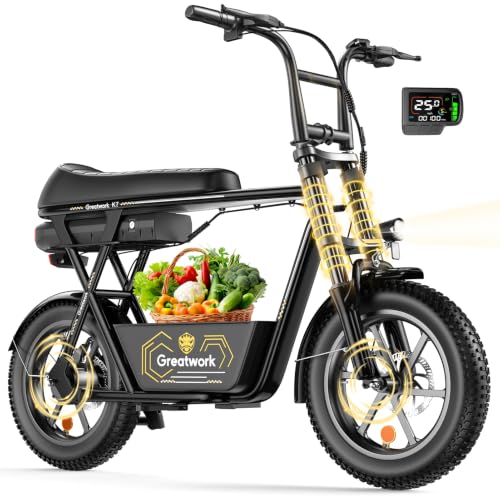
The ASKGO 20-inch fat tire electric bike is built as a rugged, moped-inspired off-road style e-bike designed for adult and teen riders looking for substantial motor power and all-terrain versatility. With its motorcycle-style aesthetics, wide contact patch tires, and dual suspension layout, this model appeals to recreational trail explorers, suburban commuters, and riders who want a fast, heavy-duty alternative to traditional lightweight bicycles.
Propulsion is centered on a motor providing 750W continuous output, with manufacturer specifications citing peak power capabilities between 1500W and 2500W alongside speeds up to 28 to 36 mph. Electrical energy is supplied by an upgraded 48V 20Ah removable smart battery, which the manufacturer rates for up to 65 miles on a single charge under optimal conditions. In real-world use, actual mileage will vary based on rider weight, terrain gradient, throttle usage, and selected assist level. A full recharge takes approximately 6 to 8 hours, and the removable battery design lets you charge indoors without rolling the complete bike inside.
Ride dynamics and chassis stability rely on 20-inch by 4.0-inch fat tires paired with a dual front suspension fork and rear shock absorbers. This setup helps reduce vibrations across potholes, washboard gravel, and packed dirt trails. Dual disc brakes provide the necessary mechanical stopping power for higher-speed riding and slick conditions, while an integrated headlight and taillight assembly enhances visibility when riding at dusk or in low-light environments.
The cockpit features a clear handlebar-mounted LCD display showing essential data like speed, distance, battery charge, and assist modes. The bike incorporates an integrated NFC card reader, allowing riders to tap and unlock the electrical drive system instantly without physical keys. The bike arrives roughly 90% pre-assembled with necessary hand tools and instructions included, requiring basic installation of the front wheel, handlebars, pedals, and lighting before the first outing.
Potential buyers should consider a few clear tradeoffs before purchasing. The advertised top speed of up to 36 mph exceeds conventional U.S. Class 2 and Class 3 limits, meaning access to public bike lanes, city paths, and managed park trails will vary significantly depending on local municipal rules. Additionally, the moped-style frame posture and heavy 4-inch fat tires mean pedaling manually without motor assist requires noticeable effort if the battery is depleted.
For riders seeking high motor output, off-road styling, a generous 365-pound payload capacity, and convenient keyless operation for private property or open-road routes where higher-speed e-bikes are permitted, the ASKGO delivers a capable set of features. Commuters who need to carry a lightweight bicycle up apartment stairs or strictly follow 20 mph city bike lane caps may want to weigh those legal and portability limitations first.
The ASKGO e-bike is powered by a continuous 750W motor capable of reaching peak power spikes between 1500W and 2500W during intense acceleration and heavy hill climbing. This motor delivers the necessary torque to negotiate steep grades up to 45 degrees, making it well-suited for varied outdoor terrain and brisk urban acceleration.
Riders can toggle between five distinct operating modes, including pure electric throttle, a 1-to-5 level pedal assist system (PAS), cruise control, power-assisted walking mode, and standard unassisted pedaling. The 5-speed assist system allows you to balance physical effort against battery consumption depending on whether you are cruising flat pavement or climbing off-road inclines.
Energy storage is handled by an upgraded 48V 20Ah removable smart battery pack that delivers a manufacturer-listed cruising range of up to 65 miles per charge. Real-world range will naturally vary according to payload, riding habits, wind resistance, ambient temperature, and how frequently you rely on full-throttle riding.
The battery features built-in electrical safety protections designed to safeguard against overcharging and excessive discharge. Recharging from flat to full takes roughly 6 to 8 hours using a standard wall outlet. Because the battery unlatches easily, you can charge it off the bike at your desk, in an apartment, or in a garage.
The manufacturer lists top speed capabilities ranging between 28 mph and 36 mph, depending on rider weight, battery charge level, and surface conditions. Because standard U.S. e-bike definitions categorize Class 1 and Class 2 at a 20 mph limit and Class 3 at a 28 mph pedal-assist maximum, speeds above 28 mph place this model outside traditional three-class e-bike rules.
Prospective buyers should review state and local regulations regarding street legality, helmet requirements, age limits, and trail access before operating this bike on public streets, designated bike paths, or federal trail systems.

Pros
- 1000W peak brushless motor provides responsive hill-climbing assist on slopes up to 15 degrees
- Removable 480Wh battery allows convenient off-bike charging in homes, offices, or dorm rooms
- Comes equipped with daily commuting essentials including fenders, headlight, and tire reflective strips
- Front fork suspension softens shocks on uneven pavement and city streets
- 95% pre-assembled delivery reduces initial setup time
Cons
- Total weight capacity is limited to 220 pounds, which may restrict heavier riders or cargo loads
- High-carbon steel frame brings total bike weight to 50.7 pounds, making stair-climbing cumbersome
- Standard recharge cycle requires 6 to 8 hours for a full battery replenishment
The ASKGO 26-inch electric bike serves as an approachable hybrid-style electric mountain and city commuter designed for adults, college students, and daily errand runners. Built on a traditional diamond-style high-carbon steel frame, it balances entry-level pricing with practical urban utility. Riders seeking an economical alternative to public transit or an uncomplicated pedal-assist platform for neighborhood cruising will find this setup tailored to straightforward transportation needs.
Propulsion relies on a brushless motor capable of delivering 1000W of peak power, which the manufacturer notes can tackle grades up to 15 degrees. Power comes from an integrated 48V, 480Wh removable battery pack rated for up to 45 miles of range on a full charge. As with any electric bicycle, actual mileage per charge varies depending on rider weight, terrain grade, wind resistance, and the chosen level of motor assistance. Recharging the battery requires between 6 and 8 hours using the included charging setup, making overnight replenishment standard practice.
Hardware specifications emphasize daily road resilience and basic trail dampening. The bike rolls on 26" x 2.0" puncture-resistant tires equipped with reflective sidewall strips to improve visibility in dim conditions. A front suspension fork helps absorb road chatter, potholes, and cracked asphalt, while front and rear mechanical disc brakes provide consistent stopping power across dry and wet surfaces. A handlebar-mounted LCD display shows real-time metrics including speed, trip distance, and remaining battery life, supplemented by a front headlight, rear reflectors, and protective fenders.
Assembly and ongoing maintenance remain accessible for first-time e-bike owners. The bicycle ships 95% pre-assembled, requiring only basic mechanical steps to secure the front wheel, handlebars, seatpost, and pedals before initial use. Because the 480Wh battery is completely removable, apartment residents and office commuters can leave the 50.7-pound bike locked in a storage area while carrying just the battery inside to charge at a standard wall outlet. The adjustable saddle accommodates riders ranging from 5'1" to 6'6", though standard mechanical checks on brake cable tension and tire pressure should be performed regularly.
Prospective buyers must consider a few design tradeoffs inherent to this build. The high-carbon steel frame results in a total weight of 50.7 pounds, which can make carrying the bike up multiple flights of stairs or lifting it onto tall vehicle racks challenging without folding mechanisms. Additionally, the maximum payload capacity is rated at 220 pounds, which restricts heavier riders or those planning to haul significant cargo. The 6 to 8 hour charge window also means riders cannot rely on quick mid-day turnarounds if the pack is fully depleted.
For everyday commuters, university students, and recreational riders within the 220-pound load rating, the ASKGO electric mountain bike offers solid functional value. It packages essential commuter features like full fenders and lighting alongside a capable 1000W peak motor and removable battery system. If you need a straightforward, budget-conscious e-bike for paved routes, gentle hills, and suburban paths, this model presents a well-rounded starting point.
The ASKGO electric bike features a 1000W peak brushless motor engineered to provide climbing assistance on grades up to 15 degrees. Energy is supplied by a 48V, 480Wh removable battery pack that delivers a manufacturer-rated range of up to 45 miles under optimal operating conditions. Charging takes approximately 6 to 8 hours from empty to full. Riders can easily detach the battery with a key to charge it indoors, protecting the pack from outdoor temperature extremes.
Constructed around a durable high-carbon steel frame in an Ash Gray finish, this 26-inch e-bike accommodates a recommended rider height range between 5'1" and 6'6". The frame supports a maximum weight capacity of 220 pounds, including the rider and any carried gear. At a total bike weight of 50.7 pounds, the frame delivers stable road tracking supported by an adjustable seatpost that allows customized leg extension for men, women, and teen riders.

Pros
- Dual UL certifications: UL 2849 for the complete e-bike and UL 2271 for the lithium-ion battery.
- Versatile ride settings featuring five distinct modes, including cruise control and uphill walk assist.
- Removable 48V battery pack enables convenient indoor or on-bike charging in 4 to 5 hours.
- Includes standard utility components like mud fenders, an LED headlight, and front suspension.
Cons
- At 56.88 pounds, the bike is relatively heavy for frequent stair climbing or lifting onto elevated racks.
- A 374.4Wh battery capacity provides modest energy storage that will deplete quickly under continuous throttle use.
- Supplied manufacturer specifications do not state the exact brake type or maximum total payload limit.
The Loeook 26-inch electric mountain bike is designed for adult commuters, college students, and recreational weekend riders seeking an accessible entry into motorized cycling. Built around an upright frame with 26-inch wheels, this model targets riders between 5 feet 3 inches and 6 feet 1 inch tall. It provides a practical, versatile platform suited for paved neighborhood streets, urban commuter paths, and packed gravel routes.
Propulsion is delivered by a 500W nominal brushless motor capable of outputting 1000W at peak, reaching an assisted top speed of 20 mph. Riders have access to five distinct riding settings, including pure throttle operation, a five-level pedal-assist system (PAS), and standard unassisted pedaling. For specialized travel scenarios, the bike includes a cruise mode that locks in steady momentum above 6.2 mph, as well as an uphill walk-assist booster mode to ease pushing the bike on steep grades.
Energy is supplied by a 48V 374.4Wh lithium-ion battery that carries an IPX5 water-resistance rating. The battery charges in 4 to 5 hours and can be charged either while mounted on the bike or removed using the two supplied keys. The manufacturer lists a riding range of 25 to 30 miles under pure throttle power and 40 to 50 miles when using pedal assist, though individual mileage will fluctuate based on rider weight, grade, and wind resistance. Electrical construction is reinforced by recognized safety standards, with UL 2271 certification for the battery pack via SGS and whole-bike UL 2849 certification via TUV.
For ride quality and convenience, the bike features a front suspension fork designed to cushion road bumps, paired with a 7-speed mechanical drivetrain to match varied elevations. An integrated handlebar LCD screen communicates key ride data, while an integrated headlight supports low-light visibility. Full-coverage front and rear fenders come standard to shield the rider and frame from mud and road spray.
Weighing 56.88 pounds, this e-bike has substantial physical heft that buyers should consider if regular transport up apartment stairs or vehicle rack loading is necessary. While the 374.4Wh battery easily accommodates typical daily commutes, high-assist and throttle-heavy riding will drain capacity much faster than conservative pedal assist. The bike ships 85 percent pre-assembled, requiring basic final mechanical assembly before the first ride.
For everyday commuters and casual fitness cyclists who prioritize independent electrical safety certifications and flexible riding modes, the Loeook electric bike offers dependable utility. Its balance of a 1000W peak motor, front suspension, included fenders, and verified UL testing makes it a sensible and practical choice for daily neighborhood transportation.
The Loeook e-bike is powered by a 500W brushless motor capable of reaching 1000W peak power, providing dependable acceleration and a listed top speed of 20 mph across varied local terrain.
Riders can choose from five distinct operational modes: full throttle mode for effortless motorized travel, five levels of pedal assist (PAS) to balance motor output with pedal input, and a traditional pedal-only mode. For added convenience, long-pressing the minus button at speeds exceeding 6.2 mph engages cruise control, while a booster mode supplies steady low-speed power to help push the bike uphill on foot.
Electrical safety is a core focus of this model, verified by UL 2271 certification for the lithium-ion battery through SGS and comprehensive UL 2849 certification for the entire e-bike system through TUV.
The 48V 374.4Wh battery features IPX5 water resistance to handle damp road conditions and can be charged on or off the bike in approximately 4 to 5 hours. Manufacturer estimates indicate a range of 25 to 30 miles in throttle mode and 40 to 50 miles in pedal-assist mode, with actual results depending on total rider weight, terrain gradient, and assist level.
What a 48V E-Bike Speed Listing Really Means
A 48V battery does not establish a bike’s top speed. Voltage describes part of the electrical system, while the motor, controller, wheel setup, and programmed assistance behavior also affect how the bike is specified to operate. A listing that says “48V” without giving a speed should not be treated as evidence of a particular mph limit.
For the models covered here, the supplied product information lists a range of advertised speeds rather than one universal figure. The Funhang Electric Bike for Adults and Loeook Electric Bike for Adults each list a top speed of 20 mph. The ASKGO Electric Bike for Adults Teens, 1500W Peak listing states 28 or 36 mph, while the URLIFE Electric Bike for Adults title says up to 28 mph; the separate 48V removable-battery ASKGO model does not provide a top-speed figure in the supplied specifications.
Those specifications describe individual products, not all 48V e-bikes. They also don’t establish how quickly a bike accelerates or how long it can sustain a given speed. A listed top speed should be read as a product claim with its own conditions, not a guarantee for every rider, route, or riding mode.
Battery voltage is only one part of the speed picture
Voltage is not interchangeable with motor wattage, torque, battery capacity, or speed. The Funhang product listing, for example, describes a 500W motor with 1000W peak power and 66.6 N·m of torque, while also listing a 20 mph top speed. The Loeook listing describes a 500W motor with 1000W peak power and also states a 20 mph top speed.
The ASKGO high-peak-power listing uses more than one power figure: its headline says 1500W peak, while the feature information says 2500W peak and 750W continuous. Those figures should not be merged into a single rating or treated as a guaranteed speed calculation. The listed speed and power statements come from that product’s supplied description and do not prove that another 48V bike with a different motor will reach the same speed.
Battery capacity is another separate specification. The Funhang and URLIFE listings each identify a 48V, 13Ah battery, while the ASKGO high-peak-power listing names a 48V, 20Ah battery. Amp-hours describe battery capacity information, not a direct speed rating. The listed battery capacity may be useful for understanding the system and the manufacturer’s range claim, but it does not by itself establish top speed.
How to interpret the speed figures in these listings
The 20 mph figures on the Funhang and Loeook listings provide a straightforward reference for shoppers seeking a more moderate advertised speed. The URLIFE product title advertises up to 28 mph, but its supplied feature details do not state a motor wattage or a specific riding mode associated with that figure. That missing context is a reason to inspect the current product page and owner documentation rather than infer the motor’s specification.
The ASKGO high-peak-power listing states “28/36 mph,” without clarifying in the supplied details exactly what distinguishes those figures. A buyer should confirm which configuration or operating condition applies before relying on either number. The other ASKGO model’s description discusses its 1000W peak brushless motor and hill use, but provides no top speed, so a speed should not be guessed from the motor rating.
Descriptions can combine headline claims and detailed specifications in ways that need clarification. Check the product page, manual, display settings, and seller information for the exact model and configuration being offered. If a figure is ambiguous, treat it as unresolved instead of selecting the most attractive number in the listing.
Riding conditions change the speed a rider experiences
A manufacturer’s top-speed listing is not a guarantee that a rider will achieve that speed. Rider and cargo weight, terrain, wind, temperature, tire pressure, battery condition, stops, and riding style can affect how an e-bike feels and how its assistance behaves. The supplied product details themselves caution that range varies with factors such as riding style, load, and road conditions; range and speed are different outcomes, but both should be interpreted as conditional rather than certain.
Pedal-assist use and throttle use can also involve different riding experiences, but the supplied descriptions do not consistently specify the exact conditions behind every speed claim. Funhang lists five working modes, including pure electric and assisted riding, while Loeook describes throttle and pedal-assist modes. Those features do not establish that every mode reaches the same top speed.
Terrain matters to a buyer’s expectations, too. The Funhang and Loeook listings describe front suspension, while the URLIFE listing specifies 16-by-3-inch fat tires and the Funhang specifies 26-by-4-inch tires. Those details describe equipment, not a verified speed advantage or a guarantee of capability on every surface. A hill, rough route, or headwind can make a rider’s experience differ from a level-road speed claim.
For related electric-bike comparisons, a Trailmaster e-bike overview can provide another brand-focused reference, while our e-bike tire replacement guide is relevant if wheel and tire upkeep is part of your ownership planning. Tire condition and inflation matter to routine riding, but those articles should not be treated as confirmation of any particular model’s top speed.
A listed speed is not an e-bike class or an access guarantee
A product’s advertised mph figure does not, on its own, identify its legal e-bike class. Class definitions and access rules can depend on details such as how the motor provides assistance and where the bike is used, and applicable rules may vary by state, locality, trail system, land manager, and facility. Don’t infer legal status or trail access from a product title or top-speed claim.
Before buying a model advertised at a higher speed, confirm the exact configuration and check the rules that apply to your intended roads, paths, or trails. The supplied data does not establish a legal class for any of these bikes, so assigning one would be guesswork. Local requirements and the manufacturer’s documentation are more useful than assuming every 48V bike follows the same rules.
Do not modify a bike to bypass a speed setting or safety system. A faster advertised number is not a substitute for understanding the bike’s controls, operating limits, and intended use. Follow the manufacturer’s instructions and use suitable protective equipment when riding.
Choosing between a moderate and higher listed top speed
Start with the riding you expect to do, not the largest speed number in a headline. A commuter on streets with frequent stops may care about predictable assistance, fit, lights, braking configuration, and a comfortable riding position as much as the advertised maximum. A buyer considering a faster-listed model should verify the speed claim, the configuration it applies to, and whether that setup suits the routes and rules where the bike will be used.
The Funhang listing combines a 20 mph top-speed claim with a 48V, 13Ah battery, a 500W motor with 1000W peak power, and a rear rack listed with a 60-pound capacity. That rack rating is not a general bike payload rating, and the product description separately lists a 330-pound maximum weight capacity. Those cargo and rider-load details may matter to an errands-focused buyer, but they do not change the stated top speed.
The Loeook listing also states 20 mph and describes a 48V battery, a 500W motor with 1000W peak power, and a 7-speed drivetrain. Its product information lists a rider-height range of 5.3 to 6.1 feet. A buyer can compare those specific details with personal fit and intended use rather than assuming that two bikes with the same listed speed will feel identical.
The URLIFE listing advertises up to 28 mph and describes a removable 48V, 13Ah battery, but the supplied data does not state its motor wattage. That makes it especially important not to fill the specification gap with assumptions based on the speed claim. Ask for clear model-specific information about the motor and applicable operating conditions if those details affect your decision.
The ASKGO high-peak-power model may attract buyers interested in its advertised 28 or 36 mph figures, 48V, 20Ah removable battery, and listed range of up to 65 miles. The range is a manufacturer claim, not a guaranteed distance, and it should not be confused with speed. The supplied description also provides conflicting peak-power statements, so confirm the exact rating and speed configuration with the seller before purchase.
The second ASKGO model may suit shoppers who value a 26-inch wheel, removable 48V battery, front suspension, and a listed range of up to 45 miles, but its supplied information does not give a top-speed figure. That absence does not mean the bike is slow or fast; it means the evidence provided here cannot settle the question. Seek a model-specific answer rather than using the other ASKGO listing as a stand-in.
Range, charging, and speed are separate buying questions
Shoppers often bundle speed and range together, but they describe different aspects of an e-bike. The Funhang listing gives a range of 30 to 35 miles in pure electric mode and 55 to 60 miles in pedal-assist mode, while the Loeook listing states 25 to 30 miles in pure electric mode and 40 to 50 miles in pedal-assist mode. These are manufacturer-listed estimates, and the product descriptions note that actual range varies with riding conditions.
The URLIFE description lists up to 40 to 60 miles in pedal-assist mode, and the high-peak-power ASKGO listing claims up to 65 miles per charge. Neither claim tells you how fast the bike will travel or guarantees that range in everyday use. If distance is a priority, compare the mode and caveats attached to each estimate instead of treating the largest number as a dependable outcome.
Charging convenience may matter as much as a headline figure for commuters. The Funhang description states that its removable battery can be charged on or off the bike and gives an approximate 6.5-hour charging time. Loeook lists an approximate 4-to-5-hour charge, while the high-peak-power ASKGO listing gives approximately 6 to 8 hours.
Those charging times belong to their specific product descriptions, and charging should follow the manual for the exact bike and battery. Do not choose a charger based only on a matching connector or nominal voltage. Battery and charger compatibility depends on the specified system, and the manufacturer’s instructions should guide charging, storage, and replacement.
What to verify before relying on a speed claim
First, match the speed figure to the exact model and configuration, especially if a listing gives more than one number or uses wording such as “up to.” Check whether the seller explains the operating mode and any conditions associated with the claim. If the product page and manual do not clarify the figure, contact the seller rather than inferring an answer from battery voltage or motor peak power.
Next, separate the specifications that answer different questions. Voltage identifies one electrical-system attribute; amp-hours describe battery capacity; watts describe motor power ratings; torque is expressed separately; and mph is a speed claim. These numbers are not interchangeable, and no one figure is enough to predict a bike’s full riding behavior.
Then review rider fit, weight limits, braking equipment, lighting, and included controls in the same model-specific documentation. The supplied products vary in wheel and tire sizes, listed rider-height ranges, brake descriptions, and rack details, so a speed comparison alone leaves out practical ownership differences. Confirm any missing information before ordering, particularly if the bike will be used for commuting, carrying gear, or riding on routes with local access restrictions.
Finally, treat certification language as specific to the product and the certification scope stated in its documentation. The Funhang and Loeook descriptions identify UL 2849 for the whole e-bike and UL 2271 for the lithium-ion battery, with named third-party recognition in the supplied information. Those statements apply to those listed products as described; they should not be generalized to the URLIFE or ASKGO models, whose supplied details do not establish the same certifications.
The practical answer is that a 48V e-bike has no single standard top speed: the listings here range from stated 20 mph models to products advertised at higher speeds, with one model lacking a supplied speed figure. Compare exact model specifications, clarify ambiguous claims, and check local-use requirements before buying. That approach gives a more reliable basis for choosing than treating 48V as a speed promise.



Write Your Review
No reviews yet. Be the first to share your experience!